About Me

My photo
Science communication is important in today's technologically advanced society. A good part of the adult community is not science savvy and lacks the background to make sense of rapidly changing technology. My blog attempts to help by publishing articles of general interest in an easy to read and understand format without using mathematics. You can contact me at ektalks@yahoo.co.uk

Thursday, 9 December 2021

PART 1: Climate Change Course at CLL, Strathclyde University, Scotland (October - November 2021)

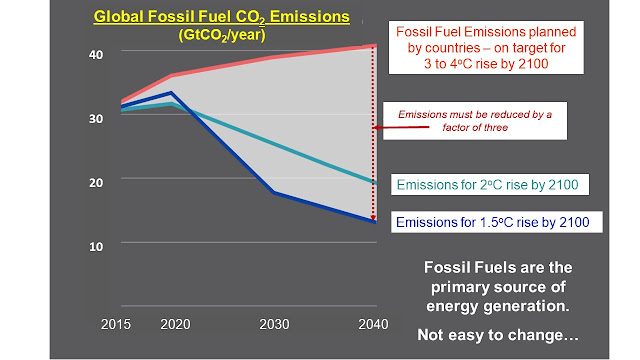
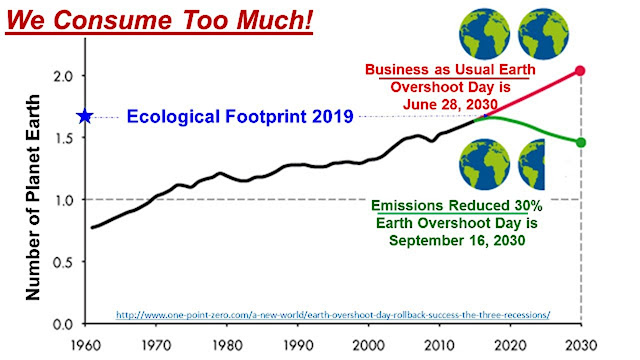
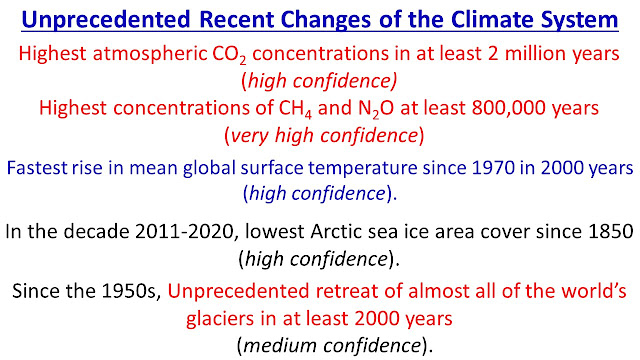
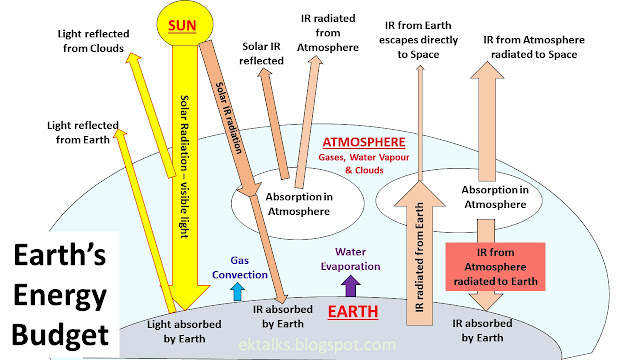
 In the following, I am publishing the slides of my lectures on Climate Change (via ZOOM) at the Centre for Lifelong Learning, Strathclyde University. I had an excellent audience who were motivated to learn about this important subject.  The course was planned to coincide with COP26 in Glasgow - this made the subject even more topical and generated a lot of interest and questions.  

The slides detail the subject material as presented in the lectures (9 hours in total) - of course, details of my presentation/discussion are missing but I hope this material will be a useful reference in understanding the science and the issues relating to climate change.  More details may be found on individual topics in my blogs published on this website in previous years.

Slides for Part 2 of the course may be seen here.

Click on a slide to view its full screen image. 


Saturday, 18 September 2021

q = sqrt(N+k) - sqrt(N-k); An Interesting Mathematical problem: Maths is Fun

 Blog Contents and Who am I?

After publishing my blog yesterday on an interesting mathematical problem, I realized that a simple variation of the problem is equally interesting and worth publishing too.  This I do in the following.

(Click on the slide to see its full page image)


Equations 3, 4 and 5 provide the full solution of the problem.  Only even values of q are possible and their range is defined by eqns. 3 and 4.  Eqn.5 may then be used to calculate the corresponding values of k. 

The next slide shows the allowed values of q.

The range of q is seen to be quite small - in fact for N < 50, the number of allowed q values is 4 but increases as N gets bigger .  

For example, for N = 30, q(min) = 0 and q(max) = 7.75.  Since q is an even integer, only possible values of q are 2, 4 and 6.  The corresponding values of k are (use eqn.5) 10.77, 20.40 and 27.50. 


Final Word:  I find the problem to be very instructive - particularly, it demonstrates that some serious conclusions may be obtained by initial observations of the problem.  For example, by looking at the expression in eqn.1, we could establish the range of q values - later confirmed by the general analysis.  

Plotting a graph of the results is also very useful as this provides a wholesome view of the results obtained.

I hope that you enjoyed our little excursion and agree that 'Maths is Fun'.

Friday, 17 September 2021

p = sqrt(N+k) + sqrt(N-k); An Interesting Mathematical problem: Maths is Fun

 Blog Contents and Who am I?

Recently, I came across an interesting mathematical problem on the internet that I thought could be generalised to provide much greater insight into how mathematics works.  The problem requires use of school level maths and I found it great fun to work on. 

(Click on the slide to see its full page image)


Equations 3, 4 and 5 provide the full solution of the problem.  Only even values of p are possible and their range is defined by eqns. 3 and 4.  Eqn.5 may then be used to calculate the corresponding values of k. 

The next slide shows the allowed values of p.
The range of p is seen to be quite small - in fact for N < 200, the number of allowed p values are less than four.  

For example, for N = 80, p(min) = 12.65 and p(max) = 17.89.  Since p is an even integer, only possible values of p are 14 and 16.  The corresponding values of k are (use eqn.5) 77.95 and 64. 


Final Word:  I find the problem to be very instructive - particularly, it demonstrates that some serious conclusions may be obtained by initial observations of the problem.  For example, by looking at the expression in eqn.1, we could establish the range of p values - later confirmed by the general analysis.  

Plotting a graph of the results is also very useful as this provides a wholesome view of the results obtained.

I hope that you enjoyed our little excursion and agree that 'Maths is Fun'.