About Me

My photo
Science communication is important in today's technologically advanced society. A good part of the adult community is not science savvy and lacks the background to make sense of rapidly changing technology. My blog attempts to help by publishing articles of general interest in an easy to read and understand format without using mathematics. You can contact me at ektalks@yahoo.co.uk

Monday, 25 January 2016

Plate Tectonics; Continental Drift; Radio-isotope Dating of Oceanic Crust


Geophysicist John Tuzo-Wilson (1963): 
 "It will be difficult for most of us to accept that large amounts of what we have written and taught has been erroneous".

In my seminar last week at Glasgow University I had described, from a physicist's perspective,  how Radiometric Dating (RD) is used to determine the age of the Earth and the Solar System and in that process provides an absolute time scale for geological events.  RD has played an equally important role in establishing the Continental Drift theory or Plate Tectonics on a firm footing.  What was amazing to realize is that the world’s oceans are continuously created and destroyed and that the oldest ocean crust is merely 200 million years (My) old.  In contrast, continental crusts were formed as the earth cooled 4550 million years ago and are not subject to recycling like the oceanic crusts are.  The following two slides show the measured ages of the oceanic crusts:  


The first slide is for the Atlantic Ocean while the second slide shows similar data for the oceans of the world. Youngest rocks in the crust lie along the mid-oceanic ridge where new crust is being created by extruding magma from the mantle of the Earth.  As new magma is introduced, it collects over the older magma (now solidified) and slides down by gravity as shown in slide 3, on both sides of the ridge and creates the oceanic crust.  The oldest oceanic crust is merely 180 million years old.

Forces driving plate tectonics


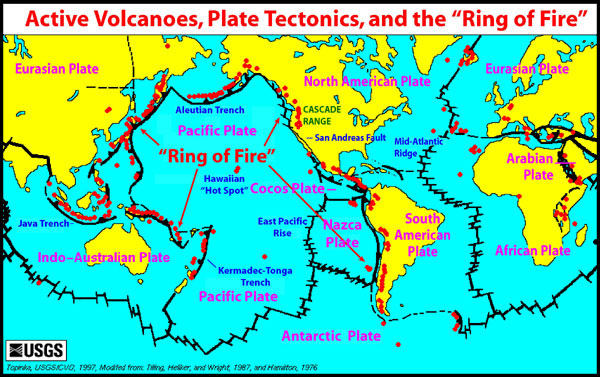
The question then is what causes the mid-oceanic ridge to extrude magma.   The continental crust is transported, albeit very slowly, by the convection currents in the mantle and as the two continental crusts move apart, space is created for magma to leak through and create what becomes the mid-oceanic ridge.  As magma solidifies, it forms igneous rock known as basalt which has a higher density (3 gm/cc).   The continental crust, largely made of silicates has a density of 2.7 gm/cc.  The oceanic crust, being heavier, subsides below the continental crust and creates a subduction zone, mixes with the mantle and melts.  Some of the molten crust seeps through the cracks in the stressed continental crust and leak out as volcanoes.  Such volcanoes form in subduction zones - 'Pacific Ring of Fire' is an excellent example of some of the regions where volcanoes occur (see slide). 


Divergent Boundaries –
Seafloor Spreading
Insert Mantle Melting
and Plate Tectonics:
Decompression Melting
Animation #52Convergent Boundaries –
Oceanic/Continental Crust
Insert Mantle Melting
and Plate Tectonics: Wet
Melting
Animation #52


Pacific Ring of Fire Plate Tectonics


.


.  


Active volcanoes (red dots) define the Pacific Ring of Fire where they form along tectonic plate boundaries. Figure modified from USGS (Topinka, 1997).


The overall topology of an ocean floor might look as in the next slide.  Sometimes the ridge may be high enough to stick out of the water level and form an island.  Iceland is an example and it sits right on top of the mid-Atlantic ridge. 


The region of the subduction zone, where the oceanic crust goes under the continental crust, there is a deep trench created and these are the places where the ocean has the greatest depths.  In the Abyssal plain, sediments from the continent deposit and form a nice flat surface.  


WHY CONTINENTS DRIFT - what causes them to move?
People had suspected for a long time that continents drift. The matching shapes of the continental boundaries were the first indications and were commented on by many scientists and others.  


Alfred Wegener 1912-15 first proposed his theory of continental drift but could not provide a credible mechanism for causing this drift.


.


Wegener's theory essentially was that about 200 million years ago, all continents were joined together as a super-continent called Pangaea meaning 'all land'.  Pangaea broke up into individual continents which drifted apart and now occupy their current positions.


There was a lot of evidence in the form of similar fossils, rock
 formations and climate found in different continents that could not be explained by any other way except by assuming that all these continents were joined together at some distant past.  Wegener's theory had firm empirical backing but the main question as to how the continents could move - what cases the movement - just could not be explained.  
Naturally a great debate started in geology with many geologists in favour and equally large numbers against the idea of drifting continents.  Arthur Holmes liked the theory and proposed that convection cells in the mantle of the Earth can provide such a mechanism.  Earth's interior was not well understood in the 1930s and the idea met with great opposition and was to some extent ridiculed. 
Holmes persevered with his theory but nothing really happened until the 1950s when firm evidence of sea-floor spreading became available and the reality of drifting continents could not be ignored.  The evidence was in the form of magnetic zebra stripes that were mapped and found to be symmetrically placed on either side of the mid-oceanic ridge.


.


The formation of magnetic zebra stripes is interesting.  Earth’s magnetic field has reversed many times over the planet’s history—with the magnetic north sometimes facing south, or vice versa, as it is today. 
When seafloor lava solidifies at the seafloor, its magnetic crystals are quenched in alignment with Earth’s magnetic field, and the rocks’ magnetic “polarity” is preserved

Radio-isotope dating of oceanic crusts tells us accurately the time that a particular part of the crust was formed.  It is then possible to calculate the rate at which oceanic floors have been increasing and continue to spread.  This is shown in the next two slides:


These days, satellite observation of fixed points on the Earth allow us to measure the spreading rates very accurately and the data in the slides reflect these measurements.

We still have to address the mechanism of continental drift - or as it is now known - plate tectonics. There is a lovely set of slides, 147 in total, that really cover the subject in great detail.  I shall briefly summarize it here.  
Our earth started life as a molten sphere with chemical composition of the Solar Nebula.  As the earth cooled, heavier metals (Iron and Nickel) sank to the bottom ( to the centre of the sphere), the lighter materials floated to form a layered structure (rich in silicon, oxygen, aluminium, calcium, potassium etc.).  This is shown in the following two slides 
Earth’s Internal Structure
• Five main layers of Earth are
based on physical properties and
mechanical strength:
– Lithosp...

 Why Does Oceanic Crust Form
Ocean Basins and Continental Crust
Form the Continents?
• Buoyancy and floating of
the Earth's...
Building on Arthur Holmes theory of convection currents in the mantle, Harry Hess developed the idea of sea-floor spreading in the 1960s. The following two slides summarize the situation
Sea Floor Spreading –
A New Hypothesis
• Seafloor Spreading
Hypothesis was
proposed by Harry
Hess in the early
1960s.
• Ce... 
Seafloor Spreading Hypothesis
• The rising magma cools at the surface and is carried away laterally
in both directions fro...
In 1965, John Tuzo Wilson put forward the theory of plate tectonics by suggesting that the Earth's crust is made of a number of rigid plates.  Plate Tectonics is an interesting subject and it is easy to get carried away with writing pages. I shall not do it here and refer you to the web site that has a detailed very readable description of plate tectonics.

Blog Content Index - Who am I?
Please send your comments to ektalks@yahoo.co.uk


Saturday, 23 January 2016

Future of Intelligence – How do we define Intelligence anyway?


In December 2015,
 at the Nobel Prize gatherings in Gothenburg, Sweden, the theme was the future of intelligence.  Ray Kurzweil was the keynote speaker – Ray is somebody I admire for his many wonderful qualities and his ability to project the technological progress in a way that sounds credible but frightens many people for what it portends.  In his projections, Ray focuses on different technologies that are changing our ability to see and understand large sets of information and create computer systems that might reach and then quickly surpass human level thinking.

Personally, I have some difficulty in understanding what intelligence is – what is the definition?  It is always good to know what one is talking about.  I did some legwork.  The results are as follows:  Intelligence is…

Collins Dictionary:  The capacity for understanding;
                               Ability to perceive and comprehend meaning
Oxford Dictionary:  The faculty of reasoning, knowing and thinking as distinct from feeling
From the Web:       A person’s cognitive abilities to learn.
                               Is an estimate of the quality that we attribute to the decision- making and abstract thinking of people around us.
                               Refers to one’s cognitive abilities which include memory, comprehension, understanding, reasoning, abstract thought.

Wiki says:  Human intelligence is the intellectual capacity of humans, which is characterized by perception, consciousnessself-awareness, and volition. Through their intelligence, humans possess the cognitive abilities to learnform conceptsunderstand, apply logic, and reason, including the capacities to recognize patterns, comprehend ideas, planproblem solvemake decisionsretain information, and use language to communicate. Intelligence enables humans to experience and think.

It became clear to me that intelligence is not something that can be measured by the IQ tests. The well-known Flynn effect (paradox) about the drastic increase of IQ score in the 20th century has its own rationalisations and make interesting reading (http://www.personalityresearch.org/papers/cherry.html)

Without getting too bogged down in defining intelligence, may be we should come back to the Nobel Week Dialog and what Ray had to say about the accelerating increase in technological progress.  I also notice that AI used to mean artificial intelligence but it is frequently used to mean accelerating intelligence – I call it the Kurzweil effect!

Ray’s keynote speech may be found at https://www.youtube.com/watch?v=9Sy3Vp7DNpE
and is very enjoyable to listen to. Particular attention should be given to the difference between linear thinking and exponential thinking.  Humans are used to linear extrapolations and that is what our common sense dictates in most circumstances.  I have some beautiful examples of exponential change in my talk on population growth
It is worth having a look at those.

Ray Kurzweil was interested in the accelerating growth of technology and gave examples of transistor price, transistor cycle time, DNA sequencing costs, growth in supercomputer power, transistor per chip and many more.  It is amazing that the smart phone in your pocket is a billion times more powerful than the computer I had in my nuclear physics lab in Canada in 1966. 
All this points to the way big data can be handled and made sense of.  This is what the human brain is so capable of doing.  With accelerating growth – I like the phrase exponential growth more – computers are getting more versatile and capabilities like pattern recognition which were impossible a few decades ago are well within the reach of super-computers.  We are not at a stage that computers can match human intelligence fully or even partially but there are signs that progress is in the correct direction.  The main bottleneck is that we still do not understand properly how the brain processes information and what gives rise to abstract thinking – where does intelligence lie in the brain?

Artificial Intelligence (AI) purports to match human intelligence sometime in the near future and then surpass it very soon after that.  Actually, it is better to think AI at three different level  http://waitbutwhy.com/2015/01/artificial-intelligence-revolution-1.html  and I quote
“1) Artificial Narrow Intelligence (ANI): Sometimes referred to as Weak AIArtificial Narrow Intelligence is AI that specializes in one area. There’s AI that can beat the world chess champion in chess, but that’s the only thing it does. Ask it to figure out a better way to store data on a hard drive, and it’ll look at you blankly.
2) Artificial General Intelligence (AGI): Sometimes referred to as Strong AI, or Human-Level AI, Artificial General Intelligence refers to a computer that is as smart as a human across the board—a machine that can perform any intellectual task that a human being can. Creating AGI is a much harder task than creating ANI, and we’re yet to do it. Professor Linda Gottfredson describes intelligence as “a very general mental capability that, among other things, involves the ability to reason, plan, solve problems, think abstractly, comprehend complex ideas, learn quickly, and learn from experience.” AGI would be able to do all of those things as easily as you can
3) Artificial Superintelligence (ASI): Oxford philosopher and leading AI thinker Nick Bostrom defines superintelligence as “an intellect that is much smarter than the best human brains in practically every field, including scientific creativity, general wisdom and social skills.” Artificial Superintelligence ranges from a computer that’s just a little smarter than a human to one that’s trillions of times smarter—across the board. ASI is the reason the topic of AI is such a spicy meatball.”

There is still a long way to go to reach ASI but with accelerating growth in technology – who knows?  There are many apprehensions, worries and expectations generated by the ever quickly developing technologies.  Ray Kurzweil neatly summarized the task at hand and again I reproduce his list of topics for discussion:
·         When will artificial intelligence exceed human intelligence?
·         Are fears of super-intelligent systems justified?
·         Does our developing relationship with technology change our brains?
·         How well do we understand the basis of human intelligence?
·         What are the economic consequences of increasingly intelligent systems?
·         What role will creativity have in the future?
·         Who will benefit and who will lose out?
·         What is the link between technology, education and inequality?
·         What will humans do when robots take over even more of our roles?
·         How can society best prepare for the changes ahead?
·         What should we learn in the future?
·         How will learning change in the decades ahead?

Blog Contents - Who am I?
Please send your comments to ektalks@yahoo.co.uk

Wednesday, 20 January 2016

Age of the Earth - Radiometric Equations - Isochrons Explained

The radiometric equations given here provide theoretical details of the construction of isochrons. Please refer to the main article for background information.  This part may be skipped without loss of continuity in the main article. 

In an actual radiometric analysis to determine the age of a sample, it is necessary to measure the abundance of the parent and daughter isotopes and also we need to know how much of these isotopes were present at the time of formation of the sample. How these abundances are related to the elapsed time (age of the sample) is determined by radiometric equations.


Now back to the main article

Please send your comments to ektalks@yahoo.co.uk

Radio-Isotope Dating: Age of the Earth - An Outreach Seminar

In the introduction to radio-isotope dating, I had indicated that recently tremendous advancements have been made in geology because now we have an absolute time clock for measuring geologically significant events - after all Geology is defined as the study of the Earth's origin, history, structure and composition.  Without a reliable way of measuring absolute time - only became available since about 1950 - Geology was in limbo - subject to much speculations and full of mysterious observations.  Geology is a science that relies very much on visual observations and measurements and there is a vast amount of data on physical features of rocks, fossils they contain, land forms, oceans and much more.  

The fundamental question in Geology has been - what is the age of the Earth? A significant step in this direction was the realization by James Hutton followed by Charles Lyell and others in the 18th and 19th centuries that rocks recycle over time - they form, erode, sediments collect and compress to form new rocks - the process repeating again and again. The sediments include in them remains of plants and animals that inhabit the Earth at that time - fossils - and the layers of such sedimentary rocks are essentially a catalogue of geological events in a time ordered fashion - just the absolute time scale is missing.  Grand Canyon is an excellent example.

The following few slides summarize the position:
(please click on a slide to view its bigger image)


The way I think of the relative geological time scale is like a stack of books arranged in the correct chronological order of the historic events as they happened but with no dates provided - as I show in the next slide


It is not that people did not try to determine a value for the age of the Earth.  It is just that the understanding of the physical processes was not good enough and all attempts gave results which were wide off the mark.  Even the church got involved and adopted the ridiculously small value of 6000 years as dogma and caused a lot of grief to lot of people.  The next few slides explain some of the attempts made


I must say that physicists and astronomers also did not help in the process of finding the correct age of the Earth.  Lord Kelvin did not know about convection currents in the molten magma in the interior of the Earth nor did he know about radioactive elements which were a source of heat energy.  But Kelvin was an eminent scientist and everybody listened carefully to what he said - in 1900 he said that the Earth is 20 million years old and that was something you do not challenge.  Evolutionary biologists did object to such a young Earth as this did not allow enough time for species to evolve etc. - a great debate - often ill tempered - ensued but there was no way out of the dilemma as to how to find a true reliable value of the age of the Earth.
In the 1920s and 30s, radio-isotope dating was getting established and was measuring ages of some rocks as 2 or more billion years.  Astronomers were discovering that the Universe is expanding and theorizing that the Universe might have started from a small compact volume less than 1.5 billion years ago. The Earth has to be younger than the Universe and this gave geologists a great deal of ammunition to aim at scientists like Arthur Holmes who believed that radio-isotope dating was a method that is capable of providing an absolute age of the earth. It should be stated that the astronomers have got their act together and in 2015 measured the Hubble constant and hence the age of the Universe as 13.8 Billion years with a tiny uncertainty.


Radioactivity was discovered in 1896 and soon it was proving useful in medical applications.  Rutherford was the first scientist to apply it for determination of age of geological samples.  Systemic errors were serious and the science of radioactivity was not understood well at that time.  Even isotopes were not known until about 1915.
This certainly gave the established geologists a big excuse to criticize the new science and it was really the solo fight by Arthur Holmes that eventually brought radio-isotope dating technique to universal acceptance by about 1950.

Let us first look at the radioactive isotopes of interest for geological dating.  It is believed that the Solar System was formed from a distribution of matter known as the Solar Nebula.  As the nebula contracted, most of the matter collapsed to form the Sun and a tiny percentage of the nebula formed the planets, asteroids, meteorites and the comets.  All of this happened over a very short period of a few hundred million years at most and it would be correct to say that our Earth formed at the same time as the Sun and the meteorites.  In fact, we can plot the abundance of elements found in the Sun and compare this to elemental abundance of early formed meteorites and find an exact correlation in these abundances. This is shown in the slide


It is now accepted that meteorites are the best objects for dating the solar system.  They were formed early on in the process for the nebula contracting and the chondrules in the meteorites have preserved their purity and initial composition at the time of their formation.  Claire Patterson have actually shown that the chondrules have similar age as some of the ocean sediment rocks confirming that they were formed at roughly the same time.

The next question is which radio-isotopes are useful for determining the age of the earth.  Unstable isotopes decay with a characteristic rate - called the half-life.  Half life is the time that an isotope will require for half of the original amount to decay to another isotope (called the daughter).  The daughter isotope may or may not be stable and can decay in turn but eventually produces a stable isotope that maintains its quantity over time.  The best isotopes are those whose half lives are similar to the age of the earth - a few billion years.  

The most frequently used isotopes for dating meteorites and earth's crustal rocks are those of uranium-238 and rubidium-87.
For dating oceanic crust, K-40 is a good choice.  These are shown in the next slide


 Carbon -14 has a short half life of 5730 years and is only useful for dating samples that are less than about 50000 years old. 
 Modern mass spectrometers are very sensitive and provide sufficient sensitivity to measure the tiny amount of radioactive isotope or the daughter product that is present in the sample.


Meteorites are good approximation to a closed system - particularly the small spherical chondrules, that meteorites contain, are very stable and have undergone little or no change since they were formed 4.65 billion years ago.
Zircon is an ideal mineral for dating terrestrial rocks.

In an actual analysis to determine the age of a sample, it is necessary to measure the abundance of the parent, daughter isotopes and also we need to know how much of these isotopes were present at the time of formation. How these abundances are related to the elapsed time (age of the sample) is determined by radiometric equations which are described in this article.  Essentially, an isochron is constructed - isochron is a straight line graph whose slope gives the age of the sample.

The first comprehensive measurement of the age of the earth was done by Claire Patterson in 1956 and we present the results obtained by Patterson which still stand.  By the way, Patterson was responsible for banning of leaded petrol - this he achieved through a thirty year struggle with the government bodies and the petrochemical industry!


In conclusion, it seems reasonable to say that the Earth came in existence at the same time as the Solar System which is about 4.568 billions of years old. 

Blog Contents - Who am I?
Please send your comments to ektalks@yahoo.co.uk
  

Thursday, 7 January 2016

Physics of Complex Organisms - Introduction


There is nothing in the Universe that does not obey the laws of nature underpinned by the theories of Quantum Mechanics and of Relativity.  Living organisms are no exception - their organization, function and size are all subject to constraints defined by the laws of nature.
There are two distinct regimes that one must distinguish here.  The function of organisms at the molecular level falls in the realm of quantum mechanics and mainly the science of chemical reactions determines this.  Evolution has fine-tuned the chemistry to an extent that it might be fair to say that all organisms share a basic optimized unit of life.  The basic unit of life is the biological cell.  Cells come in a large variety in animals and plants but they all appear to have some fundamental properties that make them self-sufficient like houses are.  (There are some fascinating websites that compare different parts and functions of a house with the organelles of a cell).  A cell is essentially a self-sustaining organism that embodies life as it is defined.  A cell has limitations in what it can achieve but these may be overcome by cells functioning together in the form of multicellular organisms.  There are many different ways that cells can join together and the numbers can get very large indeed - a human body has of the order of a million billion cells! Multi-cellular organisms are like cities where a larger number of houses exist but operate in a well-defined regulated manner to cooperate and flourish.

How cells organize themselves in multi-cellular organisms can, fortunately, be described by classical laws of nature which are much easier to visualize and understand and the physics involved is quite straightforward - it is a macroscopic system.  There are many different ways multi-cellular organisms can be constructed. With time, their design in terms of energy efficiency, strength, functionality etc. would have been optimized by natural selection working within the constraints of the laws of physics and this is what we see in today's successful animals and plants.  Of course, they all will not follow the same design - it is a question of engineering - just as an engineer works with basic materials and/or designs to construct different structures - organisms use a variety of designs and materials too.

A good example is the solution for providing oxygen more efficiently to cells over the whole body of an organism.  Diffusion, convection, circulation, hemoglobin are methods that progressively made it easier to transport oxygen over greater distances to more distant part of the body and making possible the growth in animal size. Artificial red blood cells, recpirocytes, have been proposed that will increase the oxygen carrying capacity of normal red blood cells by 236 times with corresponding increase in human endurance. This is an example where modern technology can enhance animal functionality but still working within the laws of physics.

What appears fundamental to our discussion is the size of the organism. Unfortunately, there is not a unique size for all animals or plants and they come in vastly different shapes and sizes.  For animals, the body density is very nearly 1 gm/cc and instead of the volume and shape, it is equally good to work with organism mass.  In nature we indeed have a very large range in masses; mammals alone range from a few grams for a shrew to many tons for a whale.  What is surprising is that even with this vast range of sizes, most body functions scale smoothly as some power law of body mass (allometric scaling). The relative size of the skeleton, metabolic rates, size of the brain, heart beat rate, life span and many more parameters depend on body mass and vary more or less smoothly from the tiniest to the largest of the mammals.
An interesting example to allude to here is that the heart beat rate varies as -0.25 to the power of mass while the life span varies as +0.25 to the power of the mass.  This means the smaller animal heart beats faster but they do not live as long. The total number of heart beats, equal to the product of heart beat rate and life span, for all mammals is therefore independent of their mass (size). Actually the numbers work out such that we all, from shrews to whales, are allowed about 2 billion heart beats in a lifetime!

To stretch the analogy of cells and houses further, we can think of complex organisms as cities. For efficient operation, cities too have to deliver essential commodities like water, food, energy, information etc. to all buildings just as complex organisms need to supply chemical molecules, oxygen, nerve impulses, remove toxic wastes etc. from each cell, however remote.  A system of some sort of networks must operate to maximize efficiency and smooth operation of the city or the organism.  Networks play a fundamental role in the development of complex organisms and go some way to explain their behaviour. 

How size affects animal structure and function is a fascinating subject and in future blogs, I shall look at many aspects of this topic and attempt to understand the physics involved. 

This I shall do but the next few publications will be on the question of how do we measure the age of the Earth and the Universe and where did all the elements come from!!

Blog Contents - Who am I?
Please send your comments to ektalks@yahoo.co.uk

Radio-Isotope Dating: Age of the Earth and Plate Tectonics - Introduction

'The world was created on Sunday, 23rd October 4004 BC"     …James Ussher, Irish Archbishop of Armagh
'..., this world has neither a beginning nor an end".     …James Hutton (1726 – 1797)
For the past few years, I have been giving an annual seminar to the Glasgow University Nuclear Physics Group on a topic that has something to do with nuclear physics but definitely it would have no overlap with the current research programme of the group.  I am happy to say that this year I chose to talk about radioisotope dating as applied to the determination of the age of the Earth and its contribution in establishing plate tectonics on a firm scientific basis.  With no real background in Geology, it was hard work but rather exciting to get to know better the planet we live on. 
In fact, the impact of radioisotope dating on geology and the way we now see the historic evolution of the Earth can only be described as dramatic.  In 1963, geophysicist John Tuzo-Wilson summarized:  "It will be difficult for most of us to accept that large amounts of what we have written and taught has been erroneous".
To an extent, it is not surprising that geology was in such a mess until about 1950.  There was really no absolute time scale - it was a qualitative subject - not really a proper science. This has a feeling of deja vu.  Physics suffered similar fate for almost 2000 years, biology and medicine are definitely showing signs of new life and are developing real understanding about the basis of diseases and how to cure them.
Geology is the science that deals with the history of the Earth as recorded in the rocks.  The problem has been that there was no clock, and rocks have the habit of moving about, weathering and generally changing in every way possible - typically over geological time scales - over millions of years.  Until radioisotope dating arrived properly, around 1950, only thing we could do was to visually examine rocks and chemically find out the minerals it contained.  A totally unsatisfactory situation which lends to a lot of speculative wacky  hypotheses; and the Church got involved too!
Radioactivity was discovered in 1896 and the first ideas that it can be used to date minerals in rocks came within a decade.  The first results were that many of the rocks were hundreds of millions of years old - imagine the reaction of established geologists who believed that the Earth was no more than 20 million years old.  The Church wanted us to believe that it was a mere 6000 years old.  The literature is still full of young-earth 'scientists' who are spending lot of energy in trying to prove that radioisotope dating is a flawed science and its results are misleading.  These are things that make life unique.
It took 50 years to sort out all the details in radioisotope dating method and it is now possible to say with good certainty that the Earth was created at the same time when the Solar System formed from a nebula 4.67 billion years ago.  The initial Earth was in a molten form and the crust took a few hundred million years to form.  Strictly, the Earth is slightly younger than the Solar System.  Meteorites, remnants of the early structures formed in the Solar Nebula, have proved invaluable to fix the date when the Solar System formed. 
While we are talking about the formation of the Solar System, it might be good to reflect on the age of the Milky Way - our galaxy.  It is considered that stars and galaxies started to form within about 100 to 200 million years after the big bang that created the Universe 13.7 billion years ago.  Independent determination of Be-9 abundance on the oldest stars in globular clusters at the periphery of the Milky Way puts their age at 13.6 +- 0.8 billion years. Therefore, the Solar System is much younger than the Milky Way.
Radioisotope dating provided an absolute clock and it was then possible to date past events as they happened on the Earth.  One of the most remarkable discovery was the confirmation of sea floor spreading and thus establishing the theory of continental drift or plate tectonics on a firm scientific footing.  Over the next few weeks, I shall be discussing some of these subjects from a physicist view point. 

Blog Contents - Who am I?
   

Sunday, 13 December 2015

Paris Climate Agreement - Too Little Too Late - Nations buy time to do nothing for at least 5 more years


I had made a resolution that I shall not comment on the Paris Climate Change Agreement - this was not to be; and I feel compelled to say my bit on an agreement that is not quantitative enough but a restatement of 'good intentions' albeit more cleverly drafted.  
CO2 levels have risen from about 300 ppm to 400 ppm since the Industrial Revolution - a good part coming from human activities of burning fossil fuel and deforestation.  Carbon isotope analysis has confirmed this beyond any doubt whatsoever.  People who claim otherwise are only being silly.  The average Global temperature has already risen by 0.8C and could rise by a total of 2.7C even if all the good intentions of the Paris agreement are delivered.  
It will be good to watch what the oil company share price does over the next few months - I bet that it will not crash as it should if the Paris agreement has any meaning and fossil fuel consumption is reduced.  The share price will vindicate my belief  that nations of the world will not implement what they have promised in Paris yesterday.  

The basic problem is money - Bloomberg analysis says it will cost 16500 Billion dollars to shift energy production from fossil to renewable etc. and the biggest developing economies of China and India will not be inclined to find big monies to correct a problem that USA and Europe caused and who also have greater resources.  It really boils down to sustainability.  The carbon foot print of the developed countries is far greater than the average global foot print.  A large fraction of CO2 emission from China and other developing countries goes to produce and transport goods for consumption in the developed countries.  We have got used to living on cheaply produced goods - no wonder inflation is so hard to materialize in spite of masses of Quantitative Easing by the central banks run by very clever, and very rich, people.  We have mortgaged the welfare of the next few generations already.  The climate change effects of rising sea levels, selective severe droughts and rainfalls, new diseases moving north, frequent extreme events will be just a few extra miseries they will need to cope with.

If we keep burning fossil fuels at the current level then CO2 levels will not come down - they will not be coming down in a hurry anyway as once CO2 is in the atmosphere, it will hang around there for much more than a 100 years.  We are already committed.  Emissions need to be cut - and cut drastically - to limit temperature increase to less than 2C.

General wisdom is to limit what one has to say to an A4 sheet of paper.  I could go on for a few more pages but that will be unwise.

Take care and Bye until the next time... 

Blog Contents - Who am I?