
Nanotechnology is best understood as a convergence of many technologies -
material sciences, physics, life sciences, chemistry, electrical engineering, computer science, information technology, medicine - every discipline is impacted by nanotechlogy.
In the five 90-minute talks, I had to choose my material very carefully
to provide a good comprehensive feel for the subject.
I have prepared a list of topics that
I shall be discussing in the talks starting Saturday 1st October in the lovely
lecture theatre in James Watt Building, East Kilbride Technology Park.
Talk 1: Introduction and Nanoparticles
Recent trends in technologies
Nano means dwarf; scale of things
Nano-objects behave differently
Reactivity is skin deep
Nano particles and enormous surface area
Some current examples of nanoparticles in use
Catalysis
Nanoparticles are good catalysts
Zeolites – molecular sieves
Talk 2: Seeing Nano Objects
Types of microscopes
Optical microscopes
Wave nature of the electron
Magnetic lens
Electron microscopes
Quantum tunnelling effect
Scanning tunnelling microscope
Atomic force microscope
Examples of images of nanostructures
Talk 3: Making Nano Objects; The digital Revolution
Shrinking device sizes
Top-down and bottom-up Manufacturing
Lithography
Self assembly
The information Technology Revolution – historical
Transistor and Integrated Circuit
Moore’s first and second laws – trends and limits
About robots
Examples: Nuclear plant safety, Electronic noses
Talk 4: Nature’s Nanotechnology
What has nature given us?
Photosynthesis
Artificial leaf
DNA – the molecule of life
Watson and Crick model of the DNA
Genes - coding for proteins; How Many? Junk DNA
Making new software for the cell
Recombinant DNA Technology
Learning from Nature’s achievements
Talk 5: The Story of Carbon; Nanomedicine
Many forms of carbon
Graphite and graphene
Bucky Balls – what are they and some applications
Carbon nanotubes – what are they and some applications
The space elevator
Nanomedicine
Miniature computers
Probing the cell with nanoprobes
Computerised Tomography with nanotube X-ray source
Photodynamic therapy
Nanotechnology and cancer diagnosis and treatment
Nanoparticles and Enhanced permeability and retention effect (EPR effect)
Nanoshells in cancer detection
PEBBLES – a remarkable feat of nanotechnology
Concluding Remarks
Saturday, 17 September 2011

Wednesday, 14 September 2011
The Scale of the Universe
Humans occupy an average middle place in the scheme of things.
There are vastly bigger entities and vastly smaller ones at the other end.
Our senses only allow us to see and feel things that are within a few order of magnitudes in size relative to us.
It is only in the past 200 years or less that we have been able to comprehend the vastness of space and that is where the wonderful website HTWINS gives us a glimpse of what lies beyond our limited perception.
HTWINS is wonderfully presented and graphically describes the enormous range of objects in our Universe.The only way to appreciate it is to open the link and play with it for a few minutes.
http://htwins.net/scale2/
It is almost impossible not to be impressed by it. ENJOY!
Friday, 12 August 2011
You have enough DNA to circle the Earth 4 million times!!
Unbelievable - each of us has enough DNA to circle the Earth 4 million times.
This is how it works:
If stretched, DNA in a single cell will extend to 1.5 metres**
A cell is typically 10 microns (1 micron = 10-6 m) across
Volume of a cell is of the order of 10-15 m3
Consider a 100 kg man with density equal to that of water (1000 kg/m3)
Volume of the person is 0.1 m3 (volume = mass/density)
Therefore, there are 1014 cells - this is 100,000 billion cells and
the length of the DNA is 150 billion km
This is sufficient to circle the Earth 4 million times!
** Human Genome Project has mapped 3 billion base-pairs in a human DNA. If base-pairs are 0.5 nm apart then the stretched DNA would be 1.5 m long.
Earth's circumference is about 40,000 km
Sunday, 19 December 2010
Brownian Motion - Atoms are Real afterall!
Even at the end of the 19th Century, scientists couldn't decide if atoms were real or just a convenient way to be able to calculate bulk properties of matter. Good amount of debate was going on - to the chemists it looked that atoms are real but the science of thermodynamics did not need atoms and thermodynamics was the queen of sciences at the end of the 19th Century with the Industrial Revolution providing the means of creating wealth and creating the feel-good factor in plenty.
How Einstein demonstrated the reality of atoms and counted them is fascinating.
I have published the slides of my talk on Einstein and the Theory of Relativity in the following to demonstrate how Einstein worked it out... (Click on the image for a full screen view)


Saturday, 18 December 2010
Specific Heat of Solids... Another problem with Classical Physics!
Towards the end of the 19th Century, classical physics had serious difficulties in explaing many observations. Einstein provided a solution of the specific heat of metals problem by assuming that energy absorption is quantised and is not continuous. This was a radical departure from the way physics was done in the 19th Century and demonstrates yet again the bold and visionary nature of Einstein's genius.
In the following I have published my slides from the talks on Einstein and the Theory of Relativity...


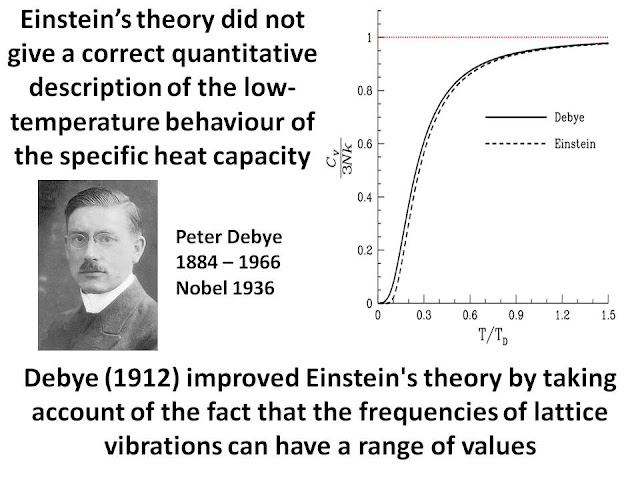
In the following I have published my slides from the talks on Einstein and the Theory of Relativity...


Sunday, 12 December 2010
Einstein Rides a Light Wave...

This is a thought experiment Einstein might have done (not necessarily in the way I have described but the idea is interesting)
A light wave is an electromagnetic wave (EM Wave) which has oscillating electric and magnetic fields. Suppose Einstein travels with the wave at the speed of light! What will he see?

A light wave is an electromagnetic wave (EM Wave) which has oscillating electric and magnetic fields. Suppose Einstein travels with the wave at the speed of light! What will he see?
He will see a constant electric field - this will not generate any oscillating magnetic field which in turn cannot generate an electric field. There will be no oscillating electric and magnetic fields that typify an EM wave. It would seem that no wave would appear to exist.
This is the interesting part - if you travel with the speed of light then you can not transmit or receive information: there are no EM waves.This encouraged Einstein to postulate that speed of light is the maximum speed allowed and nothing can move with a speed greater than the speed of light.
This is the interesting part - if you travel with the speed of light then you can not transmit or receive information: there are no EM waves.This encouraged Einstein to postulate that speed of light is the maximum speed allowed and nothing can move with a speed greater than the speed of light.
Not tremendously convincing but the idea is interesting.
Friday, 10 December 2010
On the Nature of Light: Wave-Particle Duality
Three fundamental quantities that help us to perceive the world around us
Space 3-D space - We can use a ruler to measure this
Time - Use a clock - atomic clocks can be accurate to 1 sec in a billion years
Means of transmitting information – LIGHT or EM waves in general…..
The speed of light is the fastest speed at which information/energy can travel
Speed of light is 300,000 km per second
The finite speed of light means that the time we receive the signal is later than the time the signal left the source (we are observing what happened in the past). This situation may be different for different observers and can create some bizarre effects.
Light plays a fundamental role in the theory of relativity.
Puzzling behaviour of light: Sometimes light acts as a wave while at other times it behaves like a stream of particles (photons) - Light displays a dual nature
But first a brief history:
1675 - Isaac Newton thought that light was composed of corpuscles (particles of matter) which were emitted in all directions from a source. Newton Published Optiks in 1704
Despite some serious problems with this view, Newton’s reputation helped the particle theory of light to hold sway during the 18th century
Robert Hooke (1635 - 1703) proposed in 1660 a wave theory of light.
Christiaan Huygens (1629 - 1695)in 1690 suggested that light was emitted in all directions as a series of waves in a medium called the Luminiferous ether
Thomas Young (1773 – 1829) in 1801 performed the Double-slit Interference Experiment.
Some say that it is the most beautiful experiment in physics.
The observations of the double-slit experiment could only be explained if light behaved as waves...
In 1860s, Maxwell combined the fields of electricity, magnetism and light and predicted the existence of electromagnetic (EM) waves. In his brilliant and very successful theory, Maxwell showed that all EM waves travel at 300,000 km/s which was the same as the measured speed of light.
Light is the “visible” EM wave
EM waves span a wide spectrum from radio waves to nuclear gamma rays
It was thought that as a wave motion, light would require a medium to travel - such a medium was called ether which was supposed to pervade the whole universe and had some really bizarre properties like being extremely stiff to allow vibrations of very high frequencies, be extremely thin (rare) to allow unimpeded motion of planets and objetcs through it etc. Attempts were made to measure the speed of the Earth relative to the ether but even the most sensitive experiments failed to find any evidence of the expected relative motion.
This caused a big headache for physicists at the end of the 19th Century.

Subscribe to:
Posts (Atom)