About Me

My photo
Science communication is important in today's technologically advanced society. A good part of the adult community is not science savvy and lacks the background to make sense of rapidly changing technology. My blog attempts to help by publishing articles of general interest in an easy to read and understand format without using mathematics. You can contact me at ektalks@yahoo.co.uk

Tuesday, 2 June 2015

Exploring the Cosmos: Life in Universe; Search for Extraterrestrial Life

Are earthlings the only life-form in the Universe? This is an enduring theme that must be addressed but the answer is proving surprisingly difficult to find. With hundreds of billions of galaxies, each containing billions of stars with a good fraction of them having their own planetary systems, it would seem that life should be much in abundance.  Until now, there is no evidence that life is present outside the Earth.  But as they say - "Absence of evidence is not the same as the evidence for absence".

In my talk in February 2010, I had looked at the question of search for extraterrestrial life.  It is a complex subject and the following slides of my talk will address the question in a detailed manner.  Post scripts will bring up the more recent developments.  These have increased the sensitivity of detection but the final conclusions remain the same - there is no evidence of life outside of the Earth thus far.
Most life on Earth is carbon based and derives energy from the Sun.  The main constituents of life on Earth are elements which are also the most abundant elements in the Universe.
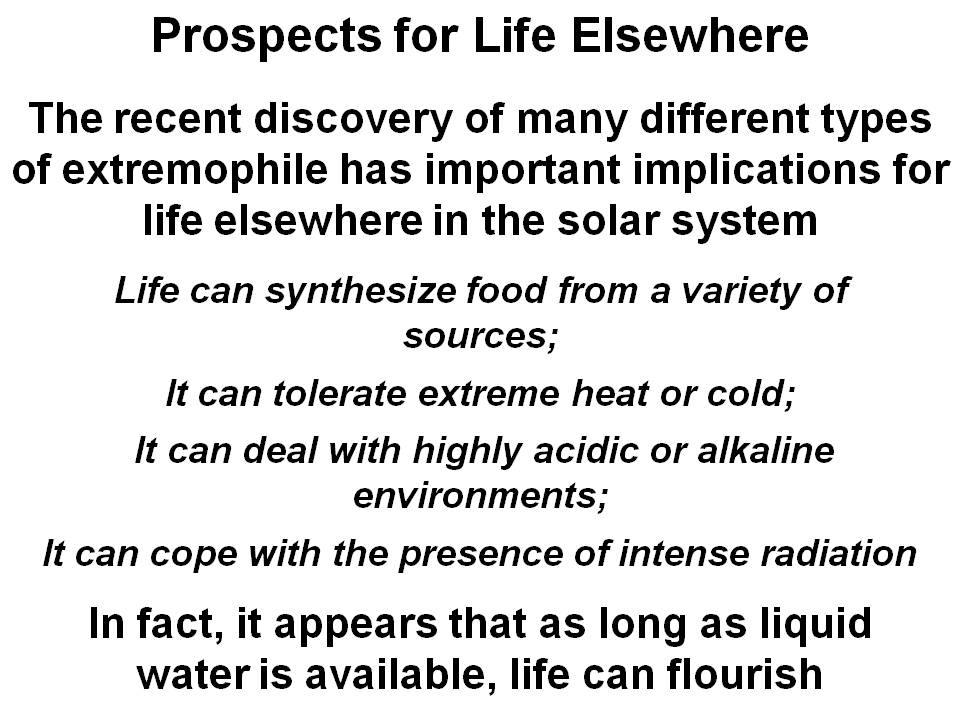
The life, as we know it, survives in an environment whose parameters can only vary within a very restricted range.  Water is considered essential. Ambient temperature, availability of nutrients and many other factors have
to be correct for life.  In the solar system, there is a region containing Earth, where life is considered possible - so called habitable zone. Search for extraterrestrial life is to some extent a search for habitable zones in other star systems.


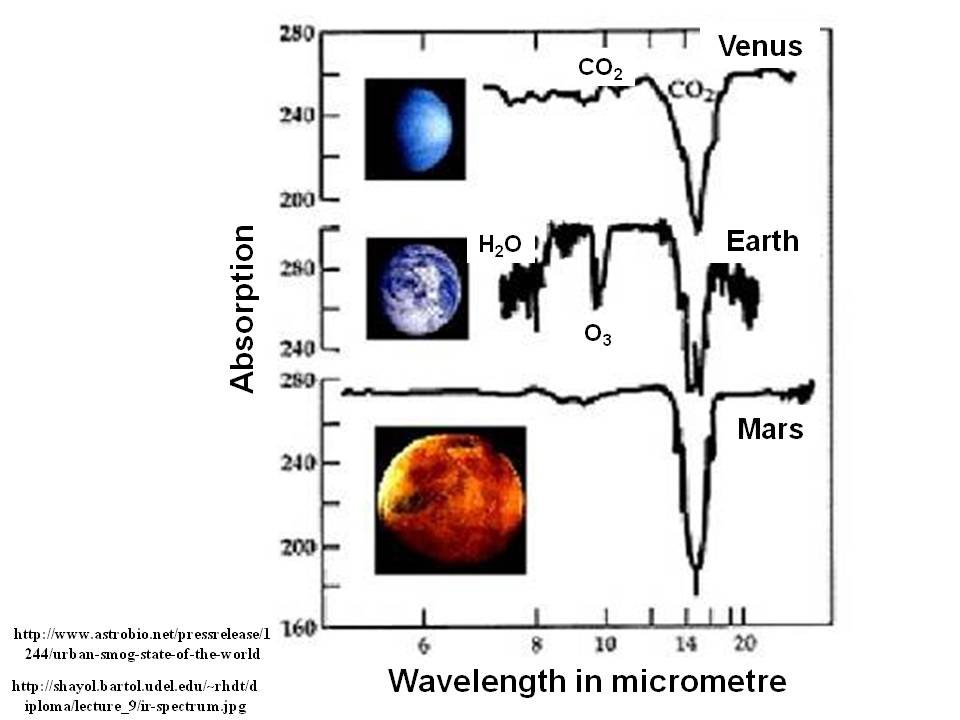
Life form interacts with the surrounding atmosphere and environment to harness and use energy for survival.  This modifies the constitution of the atmosphere  - for example, on the Earth, the atmosphere contains a complicated mixture of gases not found in the case of Mars and Venus.
It is believed that an indication of the presence of life might be inferred from a study of the atmosphere of extraterrestrial planets and lot of effort is invested in this pursuit.

While, we have not found any evidence of life elsewhere, nobody else has tried to contact us either (at least that is what we think). We are talking of intelligent, highly technologically developed life here.  Obviously, primitive life, microbial or less technologically advanced, will not communicate efficiently.


Much progress has been made since 2010 in the exploration of Mars and in the search for exoplanets.  It is now possible to detect water on some exoplanets and study the atmosphere in favourable cases.  

There is also opinion about sending messages in space declaring our existence.  This has met with lot of criticism in the sense that an aggressive civilisation, if it exits and is technologically much more advanced than we are, might wish to control us.  

Search for extraterrestrial life is a fascinating subject and I am sure you will be following the future developments with interest.  Thanks for reading.

Friday, 8 May 2015

Overcoming the problem of antibiotic resistance bacteria - a promising development

Index of Blogs and Courses

In my post on emergence of multi-drug resistance bacteria, I had pointed out the danger of medicine as we know it returning to the pre-antibiotic era.  A promising development holds out hope of success in fighting these pathogens.
The development is due to Nobel Laureate Kary Mullis and published in the 
Journal of Molecular Medicine, 2015; DOI: 10.1007/s00109-015-1280-4

This very clever idea uses pre-existing antibodies to attack and kill the pathogenic bacteria.
The way it works is to attach one end of a 'homing beacon' (or Alphamer) to the bacteria; the other end of the homing beacon is alpha-Gal, a type of sugar molecule. Humans naturally produce antibodies against alpha-Gal  because alpha-Gal is foreign to humans. Other mammals and some microbes produce it. Humans have evolved antibodies against alpha-Gal when we consume meat or are exposed to alpha-Gal-generating microbes in our environment. 
The Alphamers now tell the antibodies that alpha-Gal is present and the antibodies devour the tagged pathogenic bacteria with it. If  Alphamers continue to show promise, researchers might be able to apply the same concept to attack any type of bacteria or virus, or perhaps even cancer cells.  
The team says - “We’re picturing a future in which doctors have a case full of pathogen-specific Alphamers at their disposal.  They see an infected patient, identify the causative bacteria and pull out the appropriate Alphamer to instantly enlist the support of the immune system in curing the infection.”

Alphamers (purple) act as homing beacons, attracting pre-existing anti-alpha-Gal antibodies (green) to the bacterial surface. (credit: Altermune Technologies)

Watch the full animation at the youtube video (4 minutes) - lovely video.


The problem of antibiotic resistant bacteria is being studied by many different methods.  An entirely different method to the above is being tried and could be interesting to read about.


Saturday, 2 May 2015

Exploring the Cosmos: Powers of Ten, Historical

Index of Blogs and Courses

The Universe is vast and it is almost impossible to describe how big it is.
A good way to get some feel for the size of the Universe is to use the Powers of Ten method.  
The idea is by looking at the objects in a square of side 1 meter. Then increase the area of observation to a square of 10 meters and see what objects are present.
In each successive step increase the side by a fact of ten and in 25 steps, one is looking at an area of side 10^25 by 10^25 meters - which contains most of the observable Universe.
One can also reduce the size of the side of the square by successive factors of 10 and look at the microscopic world. 

This is most beautifully done on the website. I do hope that you will enjoy spending some time on this website - I recommend it highly.

In the following I shall publish the slides for my first talk on Exploring the Cosmos.  (Click on the slide to view its bigger image)
The first real advance in understanding the Solar system and the stars came from Aristotle (384 BC - 322 BC)
Retrograde Motion of planets:  Planets did not move in smooth circular path but looped their paths sometimes. this would be against the perfection that Aristotle's model demanded.
To explain retrograde motion, Ptolemy devised a complicated structure of perfect spheres...
Aristotle-Ptolemy Universe held sway, with the backing from the Church for almost 2000 years. Anybody who spoke against it was severely punished. 
Shorthand way of writing powers of ten.  This allows big numbers to be expressed in compact form.

 Distances are so large that they are measured in terms of the distance travelled by light in a certain time.  A light year does not measure time but the distance that light covers in one year.  A light minute is the distance that light travels in one minute.

 Just a picture of the constellation - stars we can see in the Northern sky
 Universe has a wide variety of objects that we shall talk about in this course:
 Sizes of stars vary tremendously.  The figure compares some of these:

Exploring the Cosmos: How? and Why? in Science

We humans are a curious bunch - always trying to make sense of the world we live in.  And not a bad thing it is -  the never ending quest for answers to the how? and why? of everything that happens around us has put us on top of the intellectual packing order.

In distant past the basic questions would concern about nature - particularly the ever changing pattern of the heavens.  Each tribe would have its own way of making sense of the movement of the Sun, the Moon, the planets and fixed stars.  With little empirical information, most of the natural phenomena were attributed to some almighty force  - a kind of deity.

But to our credit, the how? and why? persisted and it was not long before the Greeks came up with some very clever analysis of what might be happening up above.  This was all good philosophy - unfortunately not backed by (even ignoring) much experimental evidence.  Then, organised religion got involved too! No wonder it took 2000 years to reach some sort of sanity!
From being the centre of the Universe, the Earth is now rightly considered an average planet revolving round an average star situated in the suburb of an average galaxy.

Observation based science is merely 500 years old and it is amazing the progress we have made in such a short span of time.  The Scientific Method is what we rely on to test the validity of the answers to the how? and why?

When it comes to the study of the Cosmos, one can't help to appreciate the feeling of inadequacy. Imagine, standing in George Square in Glasgow and be asked to map out the geography of Europe.  Difficult - may be impossible. Mapping the Universe is just a little more difficult!  Remember:

The Earth and its near vicinity is the only observational point available to study the vastness of the Universe.  
The main source of information is the radiation sent by the heavenly bodies of which the Earth intercepts a tiny amount.

In such a hopeless situation, it is not unreasonable to make a whole lot of assumptions.  The laws of science are formulated, with a lot of axioms and faith, to explain what is happening on our planet.  We then assume that the same laws apply with equal rigidity and precision to the whole of the Universe at all times; past, present and future.  And we keep modifying our laws as well - along with them our view of the Universe!  Remember the 'Age of the Earth and the Sun Controversy' - because nuclear physics was not a mature field in the year 2000 and existing laws gave ridiculous answers.
Mix in a bit of human hubris  - Eddington refused to accept the prediction that a massive star can collapse to a white dwarf state only a thousand kilometer across forcing Chandrasekhar to leave Cambridge.  History is full of such incidences.  But then this is what makes us human and makes life not feel too dull and boring.

Even the two essential and fundamental theories  - Quantum Theory and Relativity - are not compatible with each other.  We couldn't do without either of them.  Does it mean that the laws of science as we know them might change drastically at some stage in the future?  How it will affect the current view of the Universe is something I do not even wish to think about.

Anyway, in the course of lectures that I gave to communities in Glasgow area and at the University of Strathclyde, I shall present the slides which explain what we know of the Universe just now.  No discussion of dark energy and dark matter will be found here.  The presentation is suitable for a nonspecialist - my public talks are advertised as aimed for 10 to 100 years old.  My oldest student (in 2010) is now 106!

The Universe is vast - unimaginably vast.  Try explaining to a 10 years old how far the nearest galaxy is and we soon find ourselves lost for words. It is interesting that children can ask questions that appear simple - like, how do we know the distance of a star or how do we know the temperature of a star or what elements it is made of.  Grown ups are much more reluctant to ask questions fearing that it will show their ignorance - not realising that these are pertinent questions for a non-specialist to explore.

I have always felt that adult education should be an important part of our education system - something we as a society have failed to address adequately.  The local authority education department in Lanarkshire refused to have anything to do with the science talks because they did not see these as relevant.  Government sponsored programmes like STEM in the UK will target school children but will not talk about organizing adult courses.

Scientists in general are too busy with research and teaching to pay serious attention about explaining their work and science and technology matters to the general public.  Most public lectures tend to be one off and too difficult to be of much benefit to the public. Serious thinking is needed in this direction.

Friday, 1 May 2015

Artificial Photosynthesis - Useful Chemical Synthesis Entirely Powered by Sunlight

In my talks on Nanotechnology, I had described an artificial leaf which could efficiently mimic the photosynthesis process.

Plants use photosynthesis to convert sunlight, water and carbon dioxide to make chemicals in the form of carbohydrates. Globally, this natural process harvests 130 Terawatts of solar energy to generate up to 115 billion metric tons of biomass annually. Even if one could harness just a fraction of this amount to make fuels and power industrial processes, our reliance on fossil fuels will be drastically reduced.


Recent work has demonstrated how artificial photosynthesis could help to make useful chemicals like plastics, medicine, fuels etc entirely powered by sunlight.  One hopes that this could one day reduce industry’s dependence on fossil fuel-derived energy by powering it with solar energy and bacteria

A nano-wire array captures sunlight, and with the help of bacteria (bacteria based bio-catalysis), converts carbon dioxide into acetate. 


Another kind of bacteria then transforms the acetate into chemical precursors that can be used to make a wide range of everyday products from antibiotics to paints, replacing fossil fuels and electrical power.

Abstract Image


The research was  done at Howard Hughes Medical Institute, Lawrence Berkeley National Laboratory, Kavli Energy NanoSciences Institute, and University of California, Berkeley and funded by the U.S. Department of Energy, the Lawrence Berkeley National Laboratory, Howard Hughes Medical Institute, the National Science Foundation and the National Institutes of Health.

Wednesday, 29 April 2015

Burton Richter's Four Laws of Societal Inertia

      Burton Richter NSF crop.jpg    
Burton Richter (b. 1931)
 (Nobel Prize for Physics 1976)

I was reading Richter's recent book 'Beyond Smoke and Mirrors' about Climate Change and Energy in the 21st Century when I came across his four laws relating to societal inertia.  I thought they are very well stated to understand why things are so difficult to change when they obviously need to be changed.

I reproduce the four laws in the following:

First Law:  The future is hard to predict because it has not happened yet.
Second Law:  No matter how good a solution is, some people will demand we wait for a better one.
Third Law:  Short term pain is a deterrent to action no matter how much good that action will do in the long run.
Fourth Law:  The largest subsidies go to technologies that deliver the most votes or campaign contributions.

I would like to add a further observation to these 
(corollary to the Fourth Law):

The rich and powerful prefer status quo and influence decisions made by administrators with scant knowledge of science and technology.

What I find interesting in these laws is that they are equally applicable to the way society might respond to the march of new technologies.  That the new technologies will benefit our civilization is far from certain and much will depend on how they are controlled and implemented.  

Tuesday, 28 April 2015

Impact of Technologies on Our Civilization - What Does the Future Hold?

Technology:  the application of scientific knowledge for practical purposes

We can trace the development of new technologies as in the figure below:

.
One of the features that distinguishes the 20th and 21st Century technologies from historic developments is miniaturization leading to nanotechnology (NT). 
Scientific understanding of matter at the atomic level and the development of fast computers have created a knowledge-based society which has helped to improve the quality of life for the vast majority of the human race.  An average person now lives with more resources at his disposal than the aristocracy did 200 years ago!

Technology is a double edged sword: it has brought tremendous benefits to people but can also cause great harm.  Fire (energy) is great for sustaining our civilization but carries destructive power to burn down our homes and cities.  

What has been different in the past 50 years or so is the rate of new technological advancements.  The rapid rate of change has created stresses in human societies who are finding the ethical, moral, legal dilemmas difficult to manage.  The situation is bound to get much worse in the future.  How will we cope?  The future is uncertain with hopes and fears for the survival of the human race itself. It is not difficult to appreciate that any one of the new technologies - nano-, bio- or artificial intelligence -  is capable of destroying life if used improperly.  In any case, the impact of new technologies will be far reaching and how we manage the new knowledge will be of paramount importance.  Technological advances can not be reversed - knowledge can not be unlearned - and the way research is done now, it is no longer possible to stop further work in a field. 

In a series of blog entries, I plan to address these questions. For my course entitled Nanotechnology 2011 in Scotland, I had discussed many of the new technologies. In order to prepare the background for my blogs, I shall first publish the PowerPoint slides of the lectures here and then take on the subject of how technologies might develop into the future with the main emphasis on how the human societies could be affected by them - for better or for worse. Unfortunately, the slides do not convey the full details of the lectures but are a good reference point for further discussion. (Click on the talk number to view the slides)

Talk 1:  The Big Science of the Extremely Tiny
Talk 2: Seeing Nano Objects  - Microscopy
Talk 3: Making Nano Structures
Talk 4: Nature's Nanotechnology
Talk 5: The Digital Revolution
Talk 6: Nanomedicine
Talk 7: The story of Carbon  

Most material in the slides is available in the public domain.  For a few of the slides, where I have not been able to acknowledge the source individually, I make a general statement of acknowledgement.