About Me

My photo
Science communication is important in today's technologically advanced society. A good part of the adult community is not science savvy and lacks the background to make sense of rapidly changing technology. My blog attempts to help by publishing articles of general interest in an easy to read and understand format without using mathematics. You can contact me at ektalks@yahoo.co.uk

Wednesday, 27 May 2020

IMO 1988 Problem 6: General Term Using School-Level Maths


Index of Blogs and Courses
Problem 6 IMO 1988:  Let a and b be positive integers 

Show that (a2b2)/(ab +1) is the square of an integer.
(Essentially, we need to find a and b such that the expression is a square).
***********************************************

Problem 6 in the 1988 International Mathematical Olympiad paper has almost reached a legendry status.  The problem is considered extremely difficult to solve - most solutions require a high level of mathematical sophistication or are long and tedious.

Using school level maths, I obtain a general term that may be used to provide a complete list of solutions.  

First we notice that the expression (a2b2)/(ab +1) is symmetric in a and b.  The problem also has some trivial solutions - for example,  a = b = 1 and 
a = 0, b = 1 (b = 0 and a = 1 is also a solution). 

We can also find a special case solution following the simple process described in the slide 


Derivation of the general solution:  In the following, I shall derive a general expression for a and b from which the rest of solutions may be obtained.  This is discussed in the following slides:


As a physicist, I need to check if eq.10 may be simplified further for some special conditions and how that might effect the answer in eq.11.  The obvious case to consider is when x and m are large - this is discussed int he next slide:


It was satisfying for me to be able to provide a general solution for all possible combinations of a and b.  Besides the solutions (a = 0, 1 or 2) and b = a(eq. 3), we have found a new class of solutions such that a must be the cube of a real positive number and b is defined by eq.10 (solutions of the problem in the form asked in IMO 1988). 

Monday, 10 February 2020

Big Data, Artificial Intelligence and Freedom - Cyber Dystopia and Beyond

Index of Blogs and Courses

'Artificial Intelligence is more profound than fire or electricity' - Sundar Pichai (CEO Alphabet)

'Country leading in AI in 2030 will rule the planet until at least 2100' - Brookings Institution Report

'If you have enough data about me, enough computing power and biological knowledge, you can hack my body, my brain, my life, and you can understand me better than I understand myself' - Yuval Harari (Historian)

Introduction:  Recently, there has been much disquiet expressed about the uncertain world that exponential rise in technology might create for our civilisation. Previous technological revolutions have, on the whole, helped us humans in creating healthier, more comfortable living conditions.  The trio of technologies; bio-, nano- and digital-, mostly developed in the second half of the 20th century, have transformed life and augmented what we can do in a big way - generally for the better.  The two most damaging aspects of technological development in the 20th century have been human population explosion and ecological collapse.  To control these global problems needed co-ordinated global action and co-operation among the nations of the world.  This was the missing element, and humans have let the situation get out of control with dangers of many unpleasant consequences in the future. 
In the 21st century, digital technology has the potential of affecting our lives in ways that was not possible in the past.  Our privacy, freedom and human rights are all at risk.  There is a fair possibility that even if nations of the world co-operate in tackling such risks (unlikely from past experience), it may not be possible to contain serious damage to our human rights. 

What is AI? - Artificial Intelligence (AI) or  intelligent machines is the concept that digital devices (computers) can make decisions based on the data being fed and are essentially able to 'think'. During the 20th century,  based on a set of instructions (algorithm) computers could perform certain tasks more efficiently - this is artificial narrow intelligence (ANI).  A chess playing computer that beats the best players is an example of ANI in action.  ANI capabilities have been increasing exponentially in terms of number of computations a computer can do per second.  The question is when will the computer match the capabilities of the human brain?  Ray Kurzweil thinks it is 2029 - others seriously doubt that, but most experts agree that it will happen in not too distant future - by about 2050. 
It is convenient to think of three stages in the development of AI - the slide explains this:
The graph explains the situation further: 
For a transition from ANI to AGI, machine learning (ML) is an essential first step. ML enables a computer system to automatically learn from real-life data and improve from experience without being explicitly programmed - the computer learns automatically without human intervention or assistance.  The amount of input data is important - the more the better - and current trends in collecting large quantities of data (Big Data - see below) is helping AI systems to progress rapidly.
In this blog, I shall restrict the discussion to the near future spanning the next few decades and try to figure out what might happen as AI evolves towards becoming human level intelligence (AGI).  

However, it is good to note that there is much ongoing discussion about the benefits of AI, how to control AI, dangers posed by ASI to human race etc. ASI will have far superior intellect than humans and will not be bound by rules made by humans. It is a moot point if ASI will act to safeguard human rights and support 'prone to irrationality' humans.  These are uncharted territories. 

Threats to Our Privacy and Freedom - Digital technology has been very useful in making our lives more interesting and industries more productive.  Over the past 40 years, technologies based on ANI and some early modest capabilities in AGI have transformed our lives beyond recognition.  This is reflected in the way the valuations of tech companies have rocketed - they now occupy seven out of ten top positions with many at trillion US dollar valuations. The slide also shows how rapidly the valuations of the tech companies have grown, and continue to do so. 
Of the seven leading tech companies, five are based in USA and two in China. The size of a company determines the power it can wield - they can seriously influence regulatory environment and use their vast funds to undermine competition and new start-ups. Tech companies also have global reach.

In order to understand why the rise of tech companies might on the whole be negative for our privacy and freedom, we first need to understand what 'big data' is.

Big Data:  
Large amounts of data is generated and collected every second.  To understand the magnitude of this, consider that you have 1 GB (10bytes) of data available for use on your smart phone every month.  The global data is estimated at 33,000,000,000,000 GB or 33 Zetabytes (33 x 1021 bytes)is increasing rapidly and is expected to reach 175 ZB by 2025. The Volume, Variety and Velocity of the data underpins the development of artificial intelligence. 
Data about us is collected in many ways - smart phones, social media, smart home appliances, consumer products etc.  Much data about us is combined and shared among commercial, government and other institutions without our consent - in fact lot of the time we are not even aware that this is happening. 
Recent advances in face- and voice- recognition software allow you to be recognised in real time.  Such AI is already used by civic authorities in many countries to monitor peoples' movements - generally without any legal authority.   
These extremely large datasets (Big Data) enable computers to reveal useful hidden patterns, market trends, customer choices etc. leading to more informed decisions.  Big data may also be analysed to extract information about multiple aspects of human behaviour on an individual and collective levels. 
Tech companies 'own' and control Big Data.  With increasing capabilities of AI, they are in a strong position to exploit the information.  Let us look at it in more detail.
AI and Threat to Privacy:  One can consider privacy in two ways:  
1) Physical privacy concerns with your location, information about friends and family, biological (genetic DNA) information - medical records, financial information etc. Such information is what Big Data collects and stores. For example, Google has just sent us a log of all the places we had visited in the past 12 months.  It also keeps record of what we have been searching on the internet (our shopping habits).  Details of our bank accounts, medical history etc. are all digitised and are available to anybody who has the authority to access these.  
2)  Privacy of Thought: was indeed so during the 20th century.  With the ever increasing speed and scale of AI, computers can analyse Big Data to profile our thoughts with increasing accuracy.  For example, the way you drive your car may be analysed to deduce your emotional states such as anxiety, alertness, distractions etc. Similar information may be obtained from your keyboard typing patterns or your speech, the way you walk etc.
Even more worrying (and sinister) developments of AI have been the way data about you and those around you may be combined to deduce practically any aspects of your thinking like your political views, sexual orientations etc and can have massive influence on your credit worthiness, employment prospects and much more.  
Output from AI is not 100% accurate all the time - it looks for the most likely result.  AI does make mistakes and this might be catastrophic for those who are wrongly targeted for actions and thoughts that they are not guilty of.  There is no appeal allowed - AI results are final.  Authorities now use AI routinely for facial recognition and gait recognition to monitor communities suspected of challenging thoughts.  How many people are wrongly convicted or harassed is a good question.

BUT THINGS ARE MUCH WORSE: It is beyond doubt that within the next decade, AI will help authorities to effectively monitor and control their people.
A far more sinister possibility is the dominance of China and USA in their AI capabilities and the dominance of privately owned tech companies to effectively enslave the populations globally.  
I had analysed this aspect of AI in my September 2018 blog  and refer you to the second half of the blog for details. Enjoy.

Friday, 24 January 2020

7.75 Billion and 415 ppm; 4C Warmer World is Really Bad News

Index of Blogs and Courses


Summary: 
(Click on a slide to see full page image)

Atmospheric CO2 levels have reached 415 ppm 


World population is over 7.75 billion 


Mean global temperature is on trajectory for 4C rise over preindustrial levels by year 2100
(Some actually say that world will be +4C hotter much sooner)


Predictions are difficult as things might change but everything points to a miserable time for human civilisation.

Introduction:  One hears slogans like 'Save the World', 'We must protect the environment', 'Planet is burning'.  The fallacy in this thinking is to assume that it is the planet (mother Earth) that needs rescuing and we humans should do the right thing and help out.

What we must be saying is that human race is suffering, quality of life is on a declining path and we need to do something to rescue the human race from their self-inflicting foolishness.  The planet has been around for over 4500 million years and has hosted various forms of life - humans only arrived a few million years ago.  Nobody will notice if we disappear in a few hundred years - Earth will live on and, in a few thousand years, erase all traces of human existence. 

Humans have been waging a war on the natural world and there can be only one winner.  We need to take note.

It is not that we have not been warned - specially in the past 50 years, there have been scientifically sound advice about the need to take action. This has not been heeded and the negative effects of human activity on the earth are beginning to be felt in a serious way. 

Earth's resources have limits - there are planetary boundaries - stay within the boundaries and the planet will continue to provide the facilities for us to live here.  Current value of services nature provides us are estimated at 130 trillion dollars!  Humans need food, water and air to survive.  There are limits to how much food, freshwater, clean air our planet can give us.  We have crossed many of the planetary boundaries and, unfortunately,  there are few sign that humans are doing enough to improve matters in the future. 

In this blog, I shall discuss why the trajectory we are on is not a good one and threatens the survival of human civilisation as we know now. I do not believe that there is an existential threat - we are not facing extinction - what is on the cards is a lot of misery for a good fraction of human population.  In general, the wealthy OECD countries will manage to mitigate some of the effects of climate change, leaving the vast populations (and that is nearly 90% of the people) suffer miserably outside OECD.  Ironically, it is the extravagant lifestyle of unbridled consumption in the wealthy countries that has been responsible for most of the damage to the environment so far.  Even today, per capita, they are the biggest consumers of planetary resources. 


Why can't Something be Done about it?

There are two factors at play that have serious effect on global warming and climate change:  Fossil Fuels and PopulationLet us look at some numbers first:

1. Fossil Fuels: We need fuel to generate energy.  Fossil fules have been the driver of industrial growth for over 250 years (see slide).  They emit CO2 that is responsible, in addition to boosting ocean acidity, for increasing global mean land and sea temperatures. The concentration of CO2 in the atmosphere has been increasing since year 1800 with USA and EU being responsible for 50% cumulative emissions even though only about 11% of the population lives there.


Notice that Coal, oil and gas provide most of the energy.  Renewables like solar and wind are barely able to supply the increase in energy demand.
Recently, much economic progress has been taking place in developing countries like China and India.  These countries have large populations and people there aspire to reach living standards long enjoyed in USA and EU.  This is a megatrend and unstoppable, and will largely be achieved by burning more fossil fuels.  They also burn more of the highly polluting coal because it is cheaper and supplies are more reliable.  The result is increasing emissions - in fact it is already happening with China now emitting 25% of global emissions - as much as USA and EU together.  India too is catching up.  
The CO2 emissions from fossil fuel use are actually increasing faster than in the past.

On the current trajectory, emissions will continue to increase over the next few decades and the atmospheric CO2 levels will continue to go up as well. Most experts are talking about global mean temperature rising by >3C by 2100 - a far cry from the 1.5C 'target' of the 2015 Paris accord.
 Scientists and activists like Greta Thunberg and David Attenborough make good points but they are up against formidable reality - for the next two to three decades, there is no energy source available that can replace the energy generated by fossil fuels. CO2 levels and global warming will continue to increase as in the past decades because the world leaders just can't move too far away from the global growth model - particularly in the developing countries where the people's expectations are at an all time high.  It is interesting to note that fossil fuel industries receive an annual subsidy of $5000 billion.

Under current policies, temperature rise of nearly 4C by the year 2100 with all its consequences is projected. An interesting question is, whether we shall end up with a 5 or 6C rise! 

2. Human Population: Our numbers have been rising exponentially.  The slide shows some details:
There are several things about this slide that are worrying.  Even with an extremely low rate of 0.1% annual increase (it is currently about 1% per year), the population will grow to 11 billion by 2100 and to 25 billion by year 3000.  Mortality rates will be lower than today and the world will be overwhelmed by the number of 60+ years old people with hardly any young children around.  The function of societies socially, economically, housing and healthwise will be very different.
More relevant for our discussion is the provision of basic necessities - feeding 11 billion population is difficult to imagine with the type of diet and waste that we indulge in these days. Massive changes to what we eat and how food is produced will have to be brought in. Much research is underway and new ideas about making more efficiently produced plant food diet are being talked about.  Freshwater supply is a big worry too. 

For the increasing populations, we shall need houses and factories - increased cement production will add  massively to CO2 emissions.  Huge area of land are currently cleared to grow food for livestocks and agriculture.  Deforestation removes trees that then results in reduced absorption of CO2 from the atmosphere.  Habitats for wildlife are lost and there is already a serious loss of bio-diversity throughout the globe.  

Already, with 7.5 billion people, the earth's resources are extremely stretched.  We live on a planet that has finite resources in terms of land, food, water and fresh air.  These planetary boundaries are at breaking point - once broken the planet does not replenish itself efficiently and a vicious chain of decline sets in.  
Many scientists feel that we are at that point already.  Controlling population is a sensitive subject and nobody has a good answer as to how this aspect of the problem can be tackled. The current policy is not to talk about it!

In the wealthy countries, humans have treated the world resources inefficiently with total disregard for conservation.  Globally, a third of the food produced is wasted.  Obesity has been a problem of the rich countries but over the past 30 years, people in developing countries are also becoming obese and suffer with all the health related problems created by obesity. 

Pollution has been a big problem in the throw away society where vast amounts of packaging (lot of it plastic) is used unnecessarily. Recycling is being encouraged and many people are talking about circular economy with the aim to achieve zero waste. 
All efforts to control pollution, diet, waste etc. are not going to deliver the required climate mitigation as long as population keeps on increasing - even at 0.1% per annum - while each of us continues to consume more.
Many experts claim that population will plateau in response to better educated and more financially independent female population.  To some extent this seems reasonable but I think that culturally humans will wish to have more children (the extent to which chinese couples tried to bypass the countries one-child policy) and under the weight of increasing number of over 60 year olds, govermnments will start encouraging higher birth rates - this is already evident in many countries. In any case, a projected population of 11 billion by year 2100 stands in sharp contrast to the much reduced carrying capacity of the earth of a few billion under a +4C scenario. Interesting times ahead...  
*************************************
Have you read: 

Making sense of Our Climate Change - Parts 1 to 6

Over-population is 'Elephant in the Room'; Why Do We Not Address the Real Problem?


Future of Food; How to feed 10 billion People? 


Arctic Ocean - Soaring Temp., Loss of Ice Cover - How Much and Why? What is the Future?


‘The only uncertainty is how long we’ll last’: a worst case scenario for the climate in 2050 - A feature article in The Guardian 15 February 2020

*************************************


A 4C warmer world is Bad News

Scientific advice has been to act to limit global warming to 2C or less at the end of the century. The residence time of CO2 in the atmosphere is several hundred years and climate change will continue for centuries beyond year 2100.  Also, the climate of the earth is determined by a number of feedback loops - disrupt enough of these and the climate may irreversibly drift towards one extreme (hot or cold) - sometimes rapidly.  The 2C warmer world is considered a limiting situation, beyond which changes can take their own momentum and could be difficult to control/reverse - so called 'tipping points' are reached. Predicting the climate then becomes difficult - almost certainly the reality will be much worse than linear models would suggest.  Also, we lock-in adverse climate change with all its consequences for a much longer period - not good for human civilisation.

Specifically, let me consider what a 4C warmer world would look like. The mean global temperature increase is exactly what it says - it is an average increase in temperature - different parts of the globe will warm by different amounts.  The poles will be warmer by 10 to 12 degrees, land area will also be warmer than 4C generally with the tropics affected most seriously.  They will become sufficiently hot and humid to make them uninhabitable.
Warmer oceans will result in more water vapour in the atmosphere and hence we shall see more intense rainfalls and higher humidity.  For ambient temerature of 37C or more, higher humidity causes heat stress and almost certainly tropics will be uninhabitable during the summer months.  
The slide shows what the world will be like at +4C.

+4C world will not be a pleasant place for 11 billion people to live.  Most regions in Africa, India, Southern China, most of USA and Brazil will be too hot or dry for agriculture and survival.  Fresh water will be a problem and populations will have to migrate north.  Canada and Siberia will be ideal places to live - infrastructure in the form of high rise, high density cities will need to be developed.
All people will have to eat plant based diet with new technologies like hydroponics widely used to safeguard fresh water and economise on land area. 
According to Professor Hans Joachim Schellnhuber, one of Europe’s most eminent climate scientists, director of the Potsdam Institute: “At 4C Earth’s … carrying capacity estimates are below 1 billion people.”

It is expected that sufficient energy can be produced by using vast solar farms in Africa, Southern Europe, India,  China and USA. 

Arctic will be ice-free most of the year and new navigational routes will connect Europe to Asia.  Phytoplankton form the base of the marine food chain.  Currently, they are plentiful in coastal areas where lots of nutrients are available.  Ocean upwelling also brings nutrients to surface and most phytoplankton are found in the northern latitudes.  They will shift further north and vast areas of the ocean will not be able to support marine life higher up in the food chain.  
Most mountain glaciers will have melted and rivers they feed will dry out.  However, intensive rains will cause frequent flooding - life will be a nightmare.

Extreme weather events will be more intense and frequent with devastating consequences.  Stronger hurricanes and frequent extensive wildfires will make life unbearable.  More than 70,000 additional deaths occurred in Europe during the extreme heatwave of 2003 - earth was only +1C hotter then!

Things might get much worse:  The scenario I have described assumes a linear progression in the response of earth systems to a warming world.  Once we hit +2C tipping points, we will expect to see unexpected events whose effects on the climate have not been included.  
For example, permfrost that holds twice as much carbon as the atmosphere will start to melt (it is already showing many sign of melting at levels that are 70 years ahead of schedule).  Melting permafrost will put large amounts of greenhouse gases (GHGs) into the atmosphere - accelerating global warming.

Oceans currently absorb about 50% of the CO2 we put in the atmosphere and there are some indications that the oceans are getting saturated with worrying implications of increased global warming.

Are There Any Hopeful Signs? 

Historically, humans have always risen to the challenges.  Even though world leaders are unable to take action because they are tied to the growth models requiring continued burning of fossil fuels and stoking global warming, there are strong signs that there is much unease at the grassroot level.  Throughout the world, activist groups are protesting and asking for action to control climate change.  Sustainable investment is being talked about that will divert funding from fossil fuel companies to more environment friendly sources of energy.  Many new ideas about new sources of energy, new ways of growing food, switching to plant based diet on a big scale, increasing energy efficiency of products etc. are all welcome signs and may help delay the +4C world by a few years.  However, rising population and absence of alternative energy sources makes the arrival of a +4C world near certainty - one can argue if it will be 2075 or 2100 or 2125?  Societal Inertia also does not help - sustained action taken in 1970 or 1980 might have solved lot of the climate change threats in a sane fashion. 

Final Word:  It will not be out of place to address the apparent paradox: In year 2100, the world is expected to be +4C warmer with a carrying capacity of one billion people; what will happen to the remaining 10 billion?
First of all, it will be a gradual process - as parts of the world become uninhabitable and coastal cities start flooding, there will be a mass migration towards more northern latitudes.  Siberia is already part of Russia, USA will annex Canada and Greenland by force and China will occupy Mongolia -  the superpowers will accommodate their populations okay but the rest of the world - particularly 1.8 billion people of India will have no where to go.  Many deaths will occur in the conflicts between indigenous populations of the north and migrants (who, if accepted, will be subjected to subhuman treatment).  
With a large number of existential issues, World War 3 (WW3) is quite likely.  Barring natural catastrophies like an asteroid strike or a super-volcano, other events could cause millions to die - for example,  a virulent strain of a virus or widespread famines due to failure of monsoon rains and diseases due to polluted water supplies.

Going around is a crazy notion (by some eminent people) that somehow, when the earth becomes too crowded and polluted, we can colonize other planets and heavenly bodies in space.  This is a hopelessly poor suggestion - I have discussed the matter of 'hype about space colonization' here

However, I think the biggest threat will come from artificial intelligence that can prosper irrespective of the state of the climate. The super-artificial intelligence (SAI) might see no need of human existence.  As I have said before - interesting times ahead...

Thanks for reading.

Wednesday, 18 December 2019

Climate Change; Indecision at COP25 in Madrid; Fiddling as the Planet Burns

Index of Blogs and Courses

COP25 in Madrid has ended and COP26 will happen in Glasgow next year to continue the discussions.  Everybody has been disappointed that COP25 did not achieve anything of value - I am surprised that people were disappointed.  COPs are talking shops where they say good words and express concerns but by their very structure, they are not supposed to achieve anything much of value.  This has been going on since Kyoto 1997.  Paris 2015 was important as it seemed that at least it was realised that global warming should be limited to below 2C in 2100 but ideally attempts would be made to keep it no more than 1.5C. I did not believe anything will happen, and I said that again before COP25 and I do not believe much will change in COP26.  The world will continue to aggravate global warming, and 3 to 4C rise by 2100 is well on the cards.

The situation is really very simple and there are  several flaws in the whole process:  
To start with, number one reason that has been driving global warming is never seriously on the agenda - population growth. More than 2.5 billion people in China and India have joined the over-consumption binge of the developed OECD countries in a big way.  Even on the assumption that global population might stabilise by year 2100, consumption from other Asian and African countries will continue to drive the need for more energy - burning more fossil fuels and aggravating global warming further.  

A second problem in meeting any global warming target is what I call the 'Coal Trap'. The world faces a dilemma about how to produce the energy required to maintain a decent functionality and meeting peoples' aspirations for better standard of living.  There is no technological solution in sight that will rid us of consuming fossil fuels by 2050 and probably much longer.  There are many projections about renewable energy that is supposed to replace fossil fuels over the next few decades.  But, look seriously and you can quickly convince yourselves that this is not for real - renewable energy, in due course, might stop the increase in the amounts of fossil fuel we use but it is not practical for them to meet the global energy demand on their own - certainly not by 2050.

And we have left it too late.  That global warming is an issue has been known for 50 years or more.  Many predictions that science made have come true but governments and business interests have tried their best to confuse the issues.  They claimed that no action was needed and no serious action was, therefore, taken.  Perversely, the intensity of action needed increases as every day goes by and there are few scientists who believe that global warming may be limited to 3C by 2100 even if nations make their best efforts from now.

Climate change control clashes head-on with Sustainability:  Our planet is able to support consumption up to a certain level - we use planetary resources that need to be replenished.  This has not been happening.  In the OECD countries, we delude ourselves by saying that we have controlled energy consumption - it is not going up.  This is dishonest - what we have done is transferred manufacturing to China, India and other developing countries and import finished goods.  Emissions from the manufactured goods elsewhere are due to our consumption - they are our emissions and we are not counting them.  Include these and OECD will be shown not to be doing so well. Net zero by 2050 as UK and EU claim for their targets will be unachievable.

Who will pay and who will make sacrifices?  Rich countries caused the global warming by their extravagant, overconsumption lifestyle over the past 200 years.  Even today, USA consumes more than 2 times energy per capita than China and 8 times more than India, and EU is not far behind.  Standard of living in OECD will have to come down substantially to reduce emissions - will it happen? Definitely not.
The cost of climate mitigation is enormous - there is no extra money in the kitty.  Central banks and poor financial judgements at government level have ensured that most economies are just ticking over - there is no slack and I can't see much enthusiasm for funding climate control measures.

Poor will suffer most, and the rich have the means to do something: 
Look at the projections of the area of the world that will be most severely affected by Climate Change.  They are the poorest areas just now and have little or no political or economic power to do anything significant.  The other group to suffer more will be the poor people in the rich countries - again they will be sidelined by the government policies that will favour the rich (they generally do anyway). Serious migration from poorer countries will happen. The question I would like to ask is whether the poor of the world will be effectively enslaved by the few rich in each country - inequality has been rising and is expected to continue on that trajectory.  With new digital technology, a kind of cyber dystopia appears the most probable outcome over the next 80 years or so.  

Making Sense of our Climate Change: 6. Carbon Isotope Studies Prove That Human are Responsible for Global Warming

Index of Blogs and Courses

Parts 1234 and 5 may be accessed here.


This post (Part 6) deals with a couple of complex concepts and may be more challenging.

Human activity is responsible for almost all the rise in atmospheric concentration of CO2 since 1990, and hence for the observed global warming.  How we can make such a firm statement is the subject of a great scientific detective story.  Essentially, from a sample of atmospheric air, we can tell what fraction of CO2 in it originated by burning fossil fuels and how much is due to plant and animal respiration.  Amazing!

The slide shows the history of global carbon emissions by burning of fossil fuels. Currently we are sending 10 gigatons of carbon per year into the atmosphere and this is causing an increase in the atmospheric CO2 levels.  Because we know how much fuel of each type is being burnt each year, it is possible to give a breakdown of contribution from different fossil fuel types.  Coal is the most polluting fuel and the recent sharp increase in its use does not bode well for future carbon emissions.


Actual measurements of atmospheric CO2 have been carried out at various laboratories since 1958.  Historic levels are derived from gases trapped in ice cores in Greenland and Antarctica.  These observations suggest that 46% of the CO2 put into the atmosphere by human activity stays in the atmosphere, increasing its concentration.  The rest is absorbed by the oceans and terrestrial biosphere.

The remaining CO2 will increase its atmospheric concentration by 2.1 ppm per year. (This can be  calculated easily and the method is shown in the slide at the end of this blog). 

In this part, I shall describe how we can actually identify the increase in atmospheric CO2 as due to the burning of fossil fuels.
    Much of the following discussion is based on the work published by NOAA.  I acknowledge Professor Jocelyn Turnbull's help for introducing me to NOAA publications on this subject.

Isotopes of Carbon:  Carbon isotope studies can tell us where the atmospheric carbon originated from and the results point unequivocally to fossil fuels as the main source of increased CO2.  
There are three isotopes of carbon that are found in nature - all isotopes of an element have the same chemical properties.  
C-12 has a mass equal to 12 atomic mass units (1 amu = 1.66 x 10⁻²⁷ kg).  
C-13 has a mass equal to 13 amu, and
C-14 (also called radiocarbon) has a mass equal to 14 amu.

C-12 and C-13 are stable, but C-14 is radioactive and decays with a half-life of 5730 years (on decay, C-14 is converted into nitrogen; the amount of C-14 in a sample is reduced by half over 5730 years).

A sample of carbon nominally contains 98.93% C-12 and 1.07% C-13.  C-14 makes up about 1 to 1.5 atoms per trillion (1012) carbon atoms. C-14 is being continually produced from N-14 in the atmosphere by cosmic rays at a more or less steady rate that determines its background concentration.  The number of C-12 and C-13 atoms remains constant in time.   

Different carbon reservoirs 'like' different isotopes; each reservoir contains different proportions of carbon isotopes - has its own isotopic fingerprint.  By examining the isotopic mixture in the atmosphere, we can determine how much CO2 is coming from and going to each reservoir.  

There are three main carbon reservoir that actively exchange CO2 (see Part 5 about Carbon Cycle).  
The terrestrial reservoir consists mainly of plants, animals and soil.  Most CO2 is exchanged between the atmosphere and the plants.  CO2 diffuses through the stomata of the leaves and then photosynthesised by plants into carbohydrates.  Both diffusion and photosynthesis prefer to uptake the lighter mass C-12 atoms in preference to the heavier C-13.  Plant material is eaten by animals and also transferred to soil - therefore, carbon in the terrestrial pool is has less C-13 than in the atmosphere.  It also has less C-14 incorporated due to the larger mass of C-14.

The top few hundred meters of ocean surface is actively involved in exchanging CO2 with the atmosphere.  The lower depths store organic carbon and dissolved CO2 and mix their contents with the upper layers on a much longer timescales of centuries or more. The upper layer of the ocean exchange carbon di-oxide with the atmosphere.  Ocean water has no preference for absorbing or outgassing C-12 over C-13.  Oceans tend to have similar carbon isotope ratios as the atmosphere.

Fossil fuels are reservoirs which have held prehistoric carbon from millions of years ago.  Human activity has brought fossil carbon in play and CO2 generated by burning fossil fuel is sent to the atmosphere in a one-way transaction.  When plants and sea creatures got buried millions of years ago, they had some C-14 present.  Dead plants do not uptake any fresh carbon. Over the long period since then, C-14 has decayed to almost zero levels (halving in amount every 5730 years) and is present in undetectable amounts in CO2 produced by burning them. Fossil fuels are derived from plants and they also have lower C-13 levels relative to C-12

Determining Relative Carbon Isotope Values in a Sample:

One uses an isotope mass spectrometer (MS) or an accelerated mass spectrometer (AMS) for determing C-13/C-12 or C-14/C-12 concentration ratios.  Spectrometers are good at telling us relative values but not so accurate for absolute values; and one makes a simultaneous measurement with a standard where the ratios are known accurately.  Comparison with the standard provides absolute isotopic ratios for the sample - these are expressed as delta values - as explained in the slide below. 
(The slide may be skipped without loss of continuity)

An Example:  We can now show how the ∆ value of the atmosphere will change by injection of CO2 produced by burning fossil fuels.  Suppose the CO2 level is 400 ppm and in a year there is net injection of 2.5 ppm CO2 from fossil fuels.  This will change the ∆ value of the atmosphere to 38.5‰ from 45‰.  From this example, we expect that         ∆ (C-14) value will decrease by about 2.6% for every 1 ppm CO2 added to the atmosphere by burning fossil fuels. 

Actual Measurements:  CO2 takes about one year to fully mix in the atmosphere with other gases.  In order to study the change in C-14 levels in the atmosphere, it is best to find a region where there is no local hot-spot of burning fossil fuels.  In a well isolated region, away from populated areas we can monitor ∆ (C-14) values over a period of time and study any changes taking place - the changes will indicate the role of fossil fuels in the changing concentration of CO2.

The next slide shows the change in ∆ (C-14) values in an isolated region of the Rocky Mountains in Colorado: 
If we make such measurements near a local industrial area then CO2 produced would not have time to mix in the atmosphere and measured ∆ (C-14) values will be lower than those obtained for an isolated region.  This is shown in the next slide:


The above discussion shows that we can not only prove conclusively that majority of the added CO2 in the atmocphere is due to human activity of burning fossil fuels but we can also determine the exact amount of the added CO2 from fossil fuels.  

δ(C-13) Values:  We can also measure changes in δ(C-13) values that can be measured with very high precision with a mass spectrometer.  Fossil fuels have a δ(C-13) of -28 ‰ while the atmosphere δ(C-13) = -8 ‰.  Therefore, carbon di-oxide produced by burning fossil fuels will reduce the δ(C-13) value of atmospheric CO2.  However, the terrestrial biosphere also exchanges CO2 with the atmosphere and will also decrease the δ(C-13) value.  The analysis is more complex but we can separate the contribution of different sources by studying changes in δ(C-13).  This discussion is outside the scope of this blog and I refer you to NOAA publication for a more detailed discussion.

*************************************
*************************************
*************************************************************************

Saturday, 14 December 2019

Making Sense of our Climate Change: 5. Carbon Cycle and the Keeling Curve

Index of Blogs and Courses

Parts 1234 and 6 may be accessed here.

Until the industrial revolution 200 years ago, the balance of carbon was largely determined by natural processes.  At a level of about 280 ppm, atmospheric carbon di-oxide was in equilibrium with the rest of the carbon in the ecosystem.  A strong volcanic eruption or higher number of forest fires might disturb the equilibrium for a short while but things were fairly stable. In the past 200 years, human activity has not only changed the land profile through deforestation and extensive farming, but humans have been burning fossil fuels that converts historic carbon ( coal, petroleum and natural gas buried underground millions of years ago) into CO2 and releases it into the atmosphere.  

The increased concentration of CO2 in the atmosphere results in other parts of the ecosystem absorbing more CO2 to reach a balance between atmospheric and land & oceanic carbon di-oxide.  However, only half of the CO2 sent to the atmosphere by human activity is removed by rebalancing the carbon cycle - the other half mixes with atmospheric gases and results in an overall increase of long term CO2 concentration in the atmosphere.  This value has gone up from 280 ppm in year 1800 to 410+ ppm in 2019.  The inevitable global warming effect has been observed to have warmed the land mass of the Earth on average by 1.1C; the sea surface temperature has risen by about 0.13C per decade over the past 100 years.  

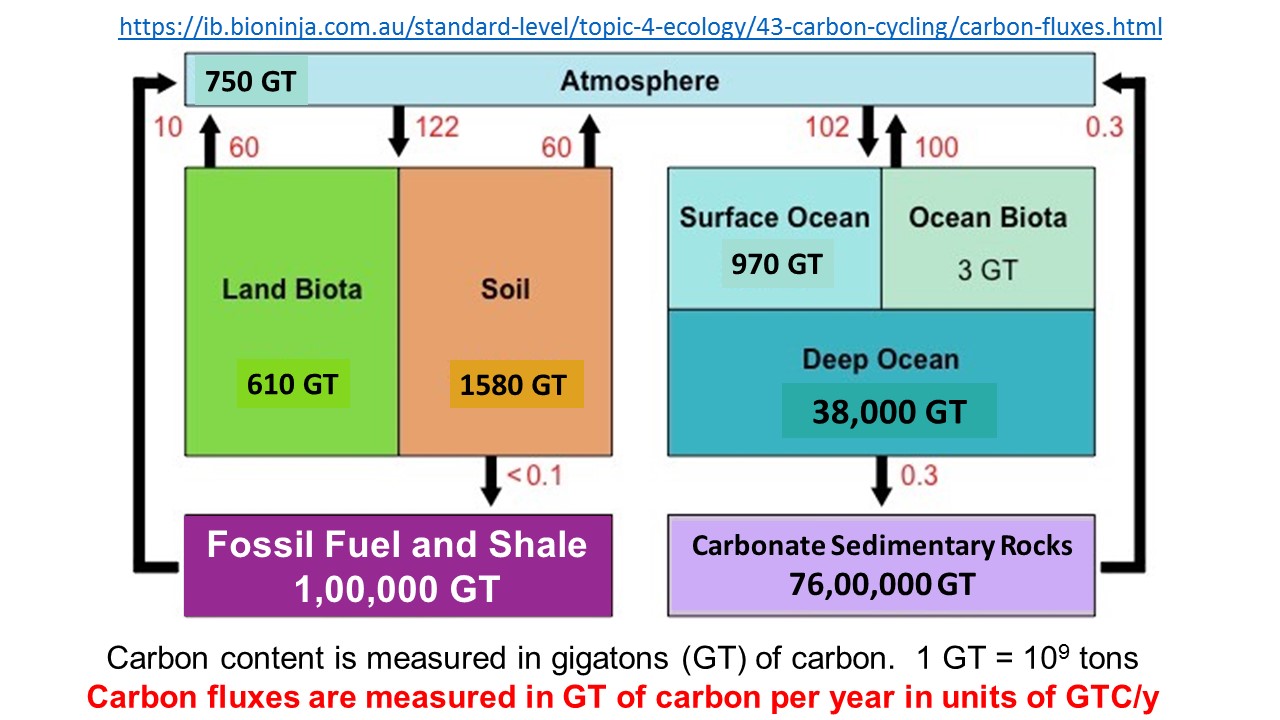
The exchange of carbon among different components of the ecosystem is described by the Carbon Cycle. Oceans and soils hold the major fraction of carbon at the Earth's surface - in the form of dissolved CO2 in the oceans and organic carbon in the soil.  Carbon inventory of the oceans is sensitive to the surface water  temperature - CO2 is less soluble in warmer waters (solubility decreases by about 3% per degree centigrade rise in temperature) and may reduce the ability of oceans to remove CO2 in future.  Deforestation and land clearance increase loss of carbon from the land. The two slides show a highly simplified view of the carbon cycle. - (Click here for a more detailed description) 


The slide provides a good summary of carbon exchange in the ecosystem.  Most exchange happens through CO2 in the atmosphere.  


Notice that the largest store of carbon is in the form of carbonate sedimentary rocks made up primarily from buried dead coral and shells of sea-creatures.  They are mostly carbonates of calcium and magnesium.  During cement manufacturing, calcium carbonate is heated and CO2 is released to the atmosphere - this provides an additional important contribution.  

In slide 2, the numbers in red give the rate of carbon release in gigatons per year (GTC/y).  For comparison, volcanic activity, on average, puts 0.1 GTC/y CO2 into the atmosphere.  The major recent addition is the burning of fossil fuels by humans at 10 GTC/y. 

The box on the right (Click on the box to expand) explains the confusing use of carbon and CO2 
interchangeably. Because carbon is in many different forms  in various inventories, it is more convenient to talk of carbon amount than of CO2.

The Keeling Curve:  In 1958, Charles Keeling (1928 - 2005) started measuring CO2 concentration in the atmosphere at the Mauna Loa Observatory (Hawaii).  Keeling curve provides a record of the progressive build-up of atmospheric CO2. Keeling first alerted the world of human activity driven greenhouse effect and global warming.
The slide shows the Keeling curve as of 2019.  Notice the ability of the measurements to pick up the variation of CO2 levels during the year.  In Northern hemisphere, plants use CO2 during the growth period from April to October and respire CO2 during the winter months.  This shows up as an oscillatory signature superimposed on the annual trend of atmospheric CO2 concentration.  The slide is adapted from Data from Dr. Pieter Tans, NOAA/ESRL and Dr. Ralph KeelingScripps Institution of Oceanography.


An important observation from the Keeling Curve is the change in slope of the curve from around 1995. The rise in CO2 concentration is more steep and it is going up at a faster rate now than previously.  This is worrying as this represents that global warming may have quickened.  The increasing slope simply reflects the situation on the ground where human activity is burning greater amounts of fossil fuels and enhancing atmospheric CO2 levels.

In Part 6, I shall explain how we can determine the contribution of human activity to the increasing amount of CO2 in the atmosphere.  In fact, as we shall see, almost all the increase in CO2 levels may be credited to human activity with natural variations playing an insignificant role.