About Me

My photo
Science communication is important in today's technologically advanced society. A good part of the adult community is not science savvy and lacks the background to make sense of rapidly changing technology. My blog attempts to help by publishing articles of general interest in an easy to read and understand format without using mathematics. You can contact me at ektalks@yahoo.co.uk

Friday, 19 February 2021

Extreme and Unique Properties of Water are Fundamental to Sustaining Life on Earth; Structure of Water, Hydrogen Bonds, Physical and Chemical Properties of Water

 Blog Contents and Who am I?

Water is an amazing substance.  Water is everywhere. Water is a compound made from hydrogen and oxygen - two elements that are the most abundant in the solar system (besides helium). 

Ø Water covers 70% of the Earth's surface.  Human body is 60+% water, as are most animals. Plants can be up to 95% water.  The biosphere seriously depends on water for its function and survival

Ø Water makes photosynthesis possible and enables production of food on which all living creatures depend for energy.

Ø Water is vital for supporting living organisms - in thermal regulation, transport of oxygen and nutrients, biochemical reactions, stability of cellular structures; many functions of the body depend on the availability of water and no other substance can replace it. 

Ø Gases in the atmosphere act as a blanket that keeps the Earth about 33⁰C warmer than it would be otherwise - making survival of complex life possible.  Water vapour provides about 60% of this 'insulation' and prevents heat energy escaping from the earth to outer space.

Ø Water in the oceans absorbs 94% of incident solar energy and helps to distribute this energy over the rest of the Earth.  At normal environmental temperatures, water is found in all three states (solid, liquid & gas).

Ø Without water, it would be impossible to maintain a steady planetary temperature and avoid severe short term fluctuations.  Earth's climate critically depends in the way water is distributed geographically.

Ø Water is called the 'universal solvent' - in rivers it brings nutrients essential for agriculture.  Water helps to dispose human waste, is vital for practically all industrial/manufacturing activity - complex civilizations critically depend on the availability of water - droughts (lack of water resources) have been responsible for the fall of many historic civilizations.    

The question is - what makes water so important for life and why no other substance can replace it? 

Compared with other materials, water has some extreme and unusual properties. Without these, earth's climate would be seriously hostile, and the life as we know will not be able to function.   

Slide 1:  


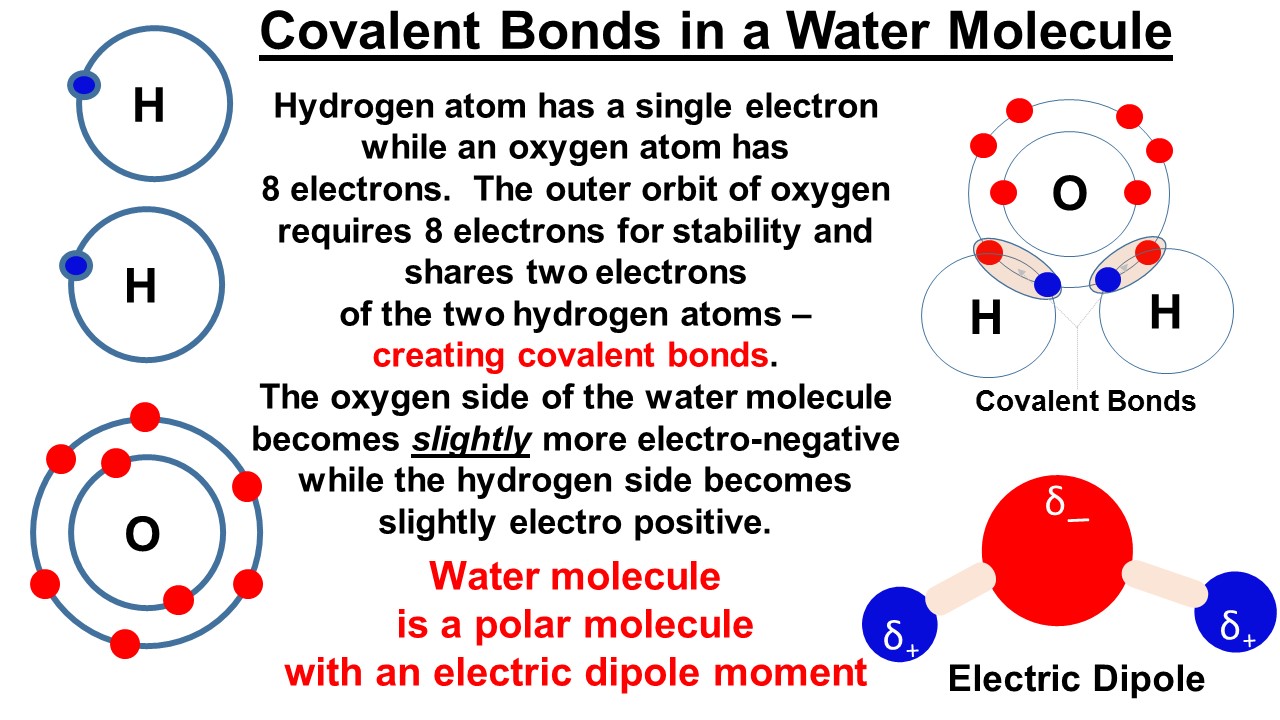
The chemistry of water, H₂O, is fascinating and mostly revolves around the way a water molecule (itself formed by the combination of one oxygen and two hydrogen atoms - covalent bonding - see slide 2) can attract other water molecules (cohesion) and also attract many other chemicals (adhesion) by forming hydrogen bonds (H-bonds).  The science of the formation of H-bonds is discussed in more detail in the Appendix. It is also worth pointing out that in water the covalent bond (intramolecular force binding oxygen and hydrogen molecules) is 20 times stronger than the hydrogen bond (intermolecular foce binding two different water molecules) - the covalent bond has a strength of ~ 460 kJ/mole while H-bonds are 23 kJ/mole. 
Slide 2:

Many physical properties of water molecules (properties 1 to 8 in slide 1) are determined by inter-molecular forces like the hydrogen bonds.  

In the following, I describe how unique and extreme many properties of water are in comparison to other substances. 

Liquid Water is Heavier than Ice - In the solid state, all substances have a higher density (mass per unit volume) than in the liquid state - except water. Water has the unique property that liquid water is heavier than it is in solid phase (ice).  The freezing point of water is 0⁰C.
Slide 3:      

Kinetic energy (energy of motion) of molecules increases linearly with temperature - at higher temperatures molecules move about more vigorously. In the case of water in solid state (ice), molecules are held in place in an hexagonal (six-sided polygon) crystalline structure with lot of empty space (for a 2-D view, see slide 4). In ice, the slightly electropositive hydrogen atoms of a water molecule form hydrogen bonds with the electronegative side of oxygen atoms of two other water molecules (see slide 4a and Appendix for hydrogen bonding). In liquid water, due to thermal motion hydrogen bonds are constantly broken and re-formed hundreds of billions times per second - allowing some water molecules to have on average somewhat smaller spacing (higher density) than in the rigid ice structure.

Slide 4:  


Slide 4a:


The strength and number of H-bonds that each water molecule can form give water its unique density profile.  As temperature is raised above zero degree, only a very small number of H-bonds are broken;  thermal motion is not sufficiently energetic to increase average spacing between water molecules (at 0⁰C, there are still 3.69 H-bonds per water molecule present), but free water molecules can enter the empty spaces of the ice crystal - the result is that the voids in ice are reduced, and the density of water increases as ice melts. It is only above 4⁰C that the increased spacing due to thermal motion causes the density of water to start decreasing with rising temperature.  

A well-known consequence of water being heavier than ice is that in colder parts of the earth (higher northern and southern latitudes), during winter months when the ambient temperature falls below freezing, the top surface of water in lakes freezes.  Ice being lighter than water stays on top - floats above the liquid water below.  Ice is also a very poor conductor of heat and the heat loss from water below it is greatly reduced with the result that water stays liquid for much longer.  As ice thickness increases, the water under it is insulated even more effectively. The liquid water enables aquatic life in the lakes to survive.

We all know that pot holes appear in roads during the winter season.  This happens because small cracks in the road surface are filled with water.  This water freezes when the temperature falls below freezing.  As ice has a larger volume than water, the newly formed ice creates a strong stress on the surrounding tarmac and cracks it - this eventually grows in size and damages the road surface.

On a larger scale, a similar process is responsible for disintegrating rocks (mechanical weathering of rocks) when water freezes in the cracks making them bigger.  In the next cycle, water would have seeped deeper into the now-bigger cracks.  The process continues until the rock disintegrates.

Food from the freezer does not taste as good as fresh food.  The reason is that in frozen food, water in the cells freezes, expands and damages some of the cell membranes. The liquid from the cells changes the texture and taste of the food.  If you refreeze the food then even more cell walls will be damaged resulting in further loss of quality.  Refreezing ice-cream is a particularly bad idea.

High Melting and Boiling Points: Water has abnormally high melting and boiling points compared with other similar compounds (slides 5 and 6).  This is due to the strength and number of hydrogen bonds (H-bonds). A water molecule can form H-bond with four other water molecules (see slide 4a).  Due to the presence of large number of relatively strong H-bonds, one requires considerably increased thermal motion to make individual water molecules free - it is estimated that even at 100⁰C, on average a water molecule has 3.24 H-bondings with neighbouring molecules. 

Slide 5: 
Slide 6: 


The above slides show the systematics that within a group, melting and boiling points decrease when hydrogen covalently combines with elements of a lower period -  see slide A1 in the Appendix for details of the periods and groups of the periodic table; without H-bonding, water would freeze around -110⁰C and boil at around -75⁰C.  If water was like other hydrides then most water on earth will readily evaporate and eventually leave the earth's atmosphere (we need to thank H-bonds that we have water on earth!).   
Water is the only substance that is present in solid (snow and ice), liquid and gaseous (water vapour, clouds) forms at temperatures that naturally occur on the earth. Our planet's weather pattern is driven by the ability of water to vaporise at prevailing temperatures - solar energy is mostly received in the tropics but is distributed over the rest of the globe by the heat carried by atmospheric water vapour and by  ocean currents. Without regular rainfall, many parts of the world will not be able to sustain agriculture and support large populations.  

High Specific Heat Capacity, Latent Heats of Fusion and Evaporation:
Slides 7, 8 and 9 show that water has exceptionally high values for the above physical properties.
Slide 7:

Slide 8:

Slide 9:


Again, these properties of water owe their extremely high values to the number and strength of H-bonds present.  The above three slides compare water with other common substances found in nature and it is obvious that water has extreme values.  Let us recap what information is there:
Specific Heat Capacity (C):  This is the amount of energy required to increase the temperature of a unit mass of liquid water by 1⁰C.  For water it is 4.18 Joule per gram or 1 calorie per gram.  
Latent Heat of Fusion (Lf): Amount of energy required to melt a unit mass of ice at 0⁰C.  It is 334 Joule per gram or 80 calorie per gram.
Latent Heat of Vaporisation (Lv): Amount of energy required to vaporise a unit mass of water at 100⁰C and 1 atmospheric pressure.  It is 2265 Joule per gram or 541.3 calorie per gram.
Lf and Lv have such high values compared to C  because in order to heat liquid water, we are simply breaking some H-bonds to let water molecules move about a bit more freely.  For fusion, we are disturbing the rather stable crystal structure of ice by removing water molecules and on average more H-bonds must be broken to do so.  Lv has the extraordinarily high value, 541 times bigger than C, and represents the need to break all H-bonds and supply enough thermal motion to water molecules to break them free from the water surface (water surface tension is also abnormally high - this is discussed later). 
Temperature Regulation:  Slide 7 tells us that it takes seven times more energy to heat water than heating sand, concrete or brick.  In the environment, light brings energy from the Sun and is absorbed by the earth's surface. Most surfaces on land become quite hot but water in the lakes and ocean never gets very warm.  Warm air flows from land to water bodies during the day and helps to cool land surfaces.  The wind direction reverses during the night when land surfaces have cooled rapidly. 
Water covers 70% of the earth's surface and with its large C value, acts as a heat reservoir without letting the ambient temperatures rise/fluctuate too much.  The large value of the specific heat of water helps to minimize temperature fluctuations helping life to survive. 

Human body maintains a core temperature of 37⁰C and will stop functioning at 42+⁰C.  When exercising or in high ambient temperatures or if you have high fever, the body produces sweat (sweat is mostly water).  Water in sweat evaporates to cool the body.    The energy required to evaporate water is drawn from the body and as Lv has a large value, sweating is a very efficient way for regulating body temperature.
_____________________________________________________
Have you read?


The Science of Heat Strokes (Hyperthermia) - When Body's Thermal Regulation Mechanism in Unable to Cope...


-----------------------------------------------------------------------------

  
Surface Tension and Capillarity of Water:  Surface Tension is the tendency of liquid surfaces to shrink into the minimum surface area possible. 
Slide 10:

Water has the highest surface tension of all liquids -  except mercury.  Mercury is a metal, and metallic bonding forces are extremely strong; this makes the surface tension in mercury very large - about 6 times greater than water.  Slide 11 lists surface tension values of common liquids:

Slide 11:

Surface tension makes the liquid surface behave like an elastic membrane. Small objects like  a small needle or insects can float on water.  In absence of other external forces, water drops are spherical - a sphere has the smallest surface area for a given volume.  External effects like gravitational forces make larger drops become more oblate.  In nature, rainbows happen because in clouds water droplets are spherical; little spheres of water drip from a leaking tap - slide 12 shows more examples:

Slide 12:
Air bubbles inside water are spherical because the  trapped air is surrounded by water.  Water surface tension forces tend to minimise the surface area of the bubble causing it to shrink in size resulting in an increase of air pressure inside the bubble. The bubble stabilises when the inward pressure due to surface tension force is equal to the ourward air pressure inside the bubble.  Slide 12 shows an example of air bubbles inside a glass of cold tap water left undisturbed for 24 hours (air bubbles form in standing water as air is less soluble in warmer water).    
Capillarity: Capillary action allows water to rise against the force of gravity inside narrow spaces.  Capillary action is due to cohesive and adhesive forces.  Cohesive forces are attractive forces between molecules of water and give rise to surface tension effects (see slide 10).  Adhesive forces are between molecules of liquid water and those in the walls of the solid container (generally glass or plastic).  Adhesive forces can be greater than cohesive forces and result in the water being pulled up in the container even against the force of gravity (capillarity or wicking).  The rise is inversely proportional to the radius of the tube (in a glass tube of radius 1 mm, water rises by 14 mm).  
There are many examples (1, 2, 3) of capillarity and surface tension at work in nature, biology, medicine and industrial processes.  

Water as a 'Universal' Solvent:  Water is an amazing solvent - water dissolves more substances (but not all) than any other liquid.  Water is ubiquitous, and always on the move in the environment and in living systems.  Water transports and delivers valuable chemicals, minerals, nutrients to make life possible. What makes water such a good solvent?  

Water molecule is a polar molecule with a large electric dipole moment (see slide 2).  Remember that while a polar molecule is overall uncharged, the internal distribution of charges is such that there are partially negative (the oxygen side in water) and partially positive regions (the hydrogen sides).  The overall effect is that the molecule has a non-zero dipole moment. The dipole moment of water is 1.84 Debye (1 Debye = 3.33 x 10⁻³⁰ Coulomb.meter) and is larger than most other polar liquids.  
Thus, water molecules feel strong attraction to other polar molecules, so much so that it can disrupt the attractive forces that hold the individual atoms of the molecule together and dissolve them. For more details please click here.

Fats, oils and most hydrocarbons do not have regions of partial positive and negative charges (they are non-polar molecules).  Electric attraction forces between water and oil & fat molecules are weak.  Therefore, they do not dissolve in water. 

Dielectric constant of a liquid provides a rough measure of its polarity - water's strong polarity is indicated by its high dielectric constant of 80.  Slide 13 shows dielectric constants of some common solvents and demonstrates how water's extreme value makes it a uniquely effective solvent for salts, ionic compounds and other polar solutes.

Slide 13:

It is worth mentioning that nonpolar solvents (shown red in slide 13) are excellent solvents for dissolving other nonpolar solutes (for example, hydrocarbons like wax).  A general rule is that 'like dissolves like'.

Final Word:  Water in the atmosphere not only provides the necessary blanket to maintain Earth at a habitable temperature, water in the oceans absorbs most of the Sun's energy falling on the Earth's surface and distributes it around the globe.  Water in the oceans also dissolves atmospheric CO₂ to reduce its amount in the atmosphere.  Dissolved oxygen in water makes aquatic life possible. I shall discuss the extremely important role of atmospheric water and oceans in the next article but leave a summary of how atmospheric water vapour does an amazing job of keeping us all warm. 
Slide 14:
Slide 15:

APPENDIX:  I discuss the science of formation, and properties of hydrogen bonds in the following. H-bonds are intermolecular attractive forces that connect two molecules.  They are formed between a hydrogen atom of one molecule and a lone electron pair of a strongly electronegative atom (nitrogen, oxygen or fluorine - the three most electronegative elements) of another molecule. 
 
Note:  H-bonds are much stronger than the relatively weak attractive van der Waal bonds which operate between neutral molecules.  Also, H-bonds should not be confused with much stronger intramolecular bonds (covalent, ionic & metallic bonds) which operate within a molecule.

Slide A1:


Slide A2:

H-bonds are formed between functional groups F-H, O-H or N-H of two molecules and are represented by 3 dots or dashes between H of one molecule and  N, O or F of a neighbouring molecule.  H, N, O and F have the smallest sizes of all atoms (slide A2) and with the greatest difference in electronegativity between H and N,O,F atoms (slide A1).  Functional groups F-H, O-H and N-H have highly concentrated partial charges (see slide 2 in the main text) and can form relatively strong electrical dipoles.  The individual molecular dipoles strongly attract to form the so-called hydrogen bonds between molecules.  The obvious examples are the three hydrides NH₃, H₂O and HF (see slide A3) of which H₂O has the most extensive hydrogen bonding - one molecule of water can H-bond with four other water molecules, giving water many unique and extreme properties (without these life on earth will not be possible!).  Slides A3 and A4 explain the situation, also see slide 4a in the main text:


Slide A3:


Slide A4:


Hydrogen bonds play a vital role in determining many of the physical and chemical properties of water.  H-bonds are also fundamental to the stability of DNA double helix structure, folding and managing 3-D shapes of proteins and formation of many organic polymers like cellulose etc.

The fact that a water molecule can form four relatively strong H-bonds with its neighbours gives liquid water strong cohesive (sticking to other water molecules) and adhesive (sticking to molecules of other substances) properties.  To make a water molecule free, one needs to break several H-bonds and this requires input of lot of energy.  In the main text, I discuss how water is unique in having extremely large latent heats of fusion and vaporisation, very high melting and boiling points, abnormally large specific heat capacity, surface tension and an anomalous density-temperature profile.  These extreme properties are due to a water molecule's ability to form H-bonds with other water molecules.
Adhesion also plays a fundamental role in nature - capillarity allows a plant to transport water to all its branches and leaves. 

H-Bonds in Other Chemical Compounds:  Hydrogen bonds are present in a large number of compounds.  In the following slides, I mention a few such bond formations that are relevant to biological molecules, but refer you to the general literature for details.

DNA:  The double helix structure owes its stability to hydrogen bonds between two set of base pairs A---T and C---G.  AT and CG are the only bonds found in DNA structure.  AT H-bonds are H---O and N---H while CG bonds are formed as H---O, N---H and O---H.
Slide A6:


Cellulose:  is the most abundant organic polymer, making up to 90% of cotton and 50% of wood, is important constituent of plant cell walls and extensively used to make paper, textiles and other industrial materials.  Cellulose is a straight chain polymer consisting of several hundred to many thousands of linked (C₆H₁₂O₅) units (is a polysaccharide - many sugars)  The C₆H₁₂O₅ structure has multiple hydroxyl groups (-OH groups).  Hydrogen atoms of the hydroxyl groups from one chain form hydrogen bonds with oxygen atoms on the same or on a neighbouring chain, holding the chains firmly side-by-side (see slide A7), forming microfibrils (thin fibre-like strands).  Because of H-bonding, microfibrils are extremely strong, tough and inflexible, and provide cellulose high structural strength.

Slide A7:


Proteins:  Proteins are integral part of the body, and are responsible for the support and repair of body tissue.  All enzymes are proteins, as are antibodies, haemoglobin in blood, myacin in muscles etc.  All proteins are made up from 20 amino acids which are joined together by covalent peptide bonds (slide A8). In a prptide bond, carbonyl group (C=O) of one amino acid is covelently bonded to the amino (N-H) group of another amino acid. Proteins are polypeptides and may contain hundreds of peptide bonds.  

The -C=O and -N-H groups are polar and can form H-bonds between diffrent peptide bonds.  Hydrogen bonds are responsible for secondary structrures of proteins and for their functions.  Slide A8 (adapted from Wiki) shows an example of H-bond formation between two polypeptide chains.

Slide A8:


The above examples demostrate that H-bonds play a primary role in the functioning of most biological systems. 

Copyright:  Some figures are modified Wiki figures but most figures have been drawn by myself and may be used provided the blog address is acknowledged.  

Wednesday, 6 January 2021

Colours in the Environment: PART 1: Sky, Clouds, Sunsets, Twilights, NLCs; Some Fascinating Physics in Play; Interaction of Light with Matter

 Blog Contents and Who am I?


Click on a slide to view its fulll page image


Our lives will be less interesting without the display of wonderful ever-changing panoramic colours in the environment - the sky is blue during the day but at sunrise and sunset it turns red/orange; clouds are white and grey but take some striking hues; oceans are blue or deep green, and may even look red sometimes.  Ice is considered white - then why a glacier, a big chunk of ice, deep blue?  We have all experienced the surprise and delight when the majestic rainbow  suddenly appears -- a double rainbow is just awesome.  

Some fascinating physics is in play to enrich our lives with these (and many other) wonderful displays.  The physics is about the way sunlight interacts with particulate matter and gas molecules (mostly oxygen and nitrogen) in the atmosphere. Light interaction with water molecules in liquid (swimming pools/ocean) and solid state (glaciers) is completely different. The physics of rainbows is different still and has already been discussed in detail here

In the atmosphere, how the particles and gas molecules scatter sunlight depends on their size, number density and on the colour (wavelength) of light.  In liquid water and ice, the internal structure of water molecules determines how longer wavelengths (yellow and red colours) are removed more efficiently than shorter 'blue' wavelengths.  

In this article, I shall delve into the science of colours in the environment with the aim to convey a greater understanding of how light and matter interact.  In Part 1, I shall discuss the colours of the sky and clouds, and deal with the case of bulk water and ice in Part 2.

You might also like________________________________________

Physics of Rainbows; Moonbows; Fogbows - All You Need to Know - an Outreach Feature for the Community

Colour of Objects: Visible Light Spectrum; Primary Colours; Optical Illusions; How Do Colours Work?

_______________________________________________________________________

To maintain continuity of presentation, some background information will be included in the Appendix.

PART 1:   Why is the sky blue during the day but at sunset it turns red?

Slide 1


As you would expect, the spectrum of light (wavelengths present) during the day and at sunset/sunrise are very different.  The detailed spectra depend on atmospheric conditions like pollution, clouds etc., but the following slide is a good example and shows the main features:

Slide 2

The way light is scattered by particles in the Earth's atmosphere is responsible for the changes in the spectrum from day to sunset.  First, we take a look at the atmospheric constituents and then study the scattering of light by these particles.  Without the atmosphere, there will be no scattering of light and the Sun will always look white and the sky pitch dark. The photograph of the Sun and surrounding sky taken from space where there are no atmospheric particles (eg from the space station or the Moon) is shown in the following slide:
Slide 3     

The Atmosphere and its Constituents:  The atmosphere extends to an altitude of 100+ km and is divided into several layers - the most important are shown in slide 4. Troposphere is the most relevant for our discussion - it contains ~80% of the atmosphere by mass and ~99% of all water and particulate matter.  Clouds and weather happen in the troposphere.  Particle size determines how light is scattered by them.  This is summarized in slides 4 & 5.

Slide 4

Slide 5

Scattering of Light by Atmospheric Particles:

I have added a brief description of the physics of how light interacts with matter particles in the Appendix.

It is convenient to identify three scattering regimes (see last column of slide 5). The important number is the scattering parameter (x = 2 𝜋 r/𝜆) which tells us how big or small a particle of radius r is relative to the wavelength of visible light (𝜆); in our case, 𝜆 covers the range from 450 nm to 700 nm. For gas molecules (oxygen and nitrogen),  the radius is equal to 0.15 nm and  x is of the order of 0.0015 - much smaller than 1; and only Rayleigh scattering needs to be considered.  Mie scattering is important when x is of the order of 0.1 to 1.0.  For larger values of x, the scattering is called geometrical (aka optical).  Slides 6,7, 8 & 9 explain the situation. Only Rayleigh scattering is strongly wavelength sensitive (1/𝜆⁴ dependence) with blue light at 450 nm scattered almost five times more strongly than red light at 650 nm.  

Slide 6

Slide 7

Slide 8

Slide 9

The probability of light scattering from a particle increases as particle size gets bigger.  Very roughly, Mie scattering can be >10000 stronger than Rayleigh scattering (see slide A2) while optical scattering increases as the square of the particle radius (click here for quantitative details).  However, note that the number density of molecules that cause Rayleigh scattering is extremely large (see slide 5), and at higher altitudes  the contribution of Rayleigh scattering is the most important.  Even with the large number of gas molecules (of the order of 10²⁵ per m³), a light photon only experiences a single scattering event in passing through the Earth's atmosphere. 

The density of aerosols at high altitudes is very low, and only at altitudes less than 5 km Mie scattering by aerosols in the troposphere becomes significant.  At even lower altitudes, geometric scattering by clouds and pollution particulates may dominate - depending on the weather and contaminants generated by natural and/or human activities.   

Another interesting feature to note is the angular distribution of scattered light - Rayleigh scattering shows a modest forward and backward peaking with only half as much light scattered along perpendicular directions (scattering is peanut shaped - see slide 6). Mie scattering is forward peaking and becomes more so for bigger particles.  In optical scattering, due to multiple scattering effects, all wavelengths are scattered more or less uniformly in all directions; for bigger particles like raindrops or ice crystals, light can enter into the particle body and produce phenomena like the rainbows.   

The Sky is Blue During the Day: We are now ready to not only explain why the sky appears blue during the day but also to analyse the varying shades of blue when one scans the sky.  Basically, the variation in blueness of the sky is due to the mixing of Rayleigh scattering (RC) with different amounts of Mie and optical scattering (MO).  
Slide 10

Slide 10 is best viewed by clicking on it for a full page image.  The blueness of the sky at various points is well reproduced by mixing different amounts of MO to RC. In fact a full spectrum of blue hues from quite sharp to very soft may be obtained this way.  This is explained in slide 11.

Slide 11

It is not advised to look directly at the Sun which is more or less white with some yellowish hue. The sky near the Sun is less blue than the sky at angles further away from it. In regions close to the Sun, some blue light is indeed scattered out from the white sunlight by Rayleigh scattering but the overall light is still nearly white. Slide 12 explains the colour of the sky near the Sun.  

Remember that when you look at any part of the sky  you are observing its features in a very small angular range (much less than a degree) and the light from the Sun can only reach you if it is scattered out of sunrays by some object.   For example, the line of sight along the direction YA shows how the scattering by aerosols (Mie and Optical scattering), redirects white light from sunrays towards the observer and dilutes the blueness of the sky due to RC.  In the absence of any atmosphere, the Sun will appear as a white disc surrounded by black sky (Slide 3). 

Slide 12


The contribution from Mie scattering decreases as one looks away from the Sun and the sky becomes progressively deeper blue.  Along the horizon away from the Sun, the path length of sunrays in the lower atmosphere is rather large and while Mie scattering contributes little, optical scattering by larger aerosol particles becomes important and the sky colour has much more whiteness (see slide 1).

An interesting observation of the scattering of light from the atmosphere is made by high flying U2 planes. They fly at about 20 km altitude - above the troposphere - and can receive Rayleigh scattered blue light from gas molecules in the atmosphere.  Also note that the outer space looks pitch dark - there are no molecules or aerosols there to scatter sunlight back towards the Earth.

Slide 12a


The Colour of Clouds:
 During the day, clouds are largely white with shades of grey. The base of large clouds is generally dark (slide 10 and 13).

Clouds consist of water droplets and/or ice crystals.  Majority of the clouds are in the troposphere  and come in many shapes and sizes.  Clouds form by water molecules condensing on an aerosol particle (dust, sea-salt, soot etc. typically of size around 0.0002 mm or 0.2 micron).  Cloud droplets may vary in size from about 20 to 3000 microns.  Low clouds are found at altitudes below about 2 km, but high clouds can form at heights from 5 to 20 km or even higher - they are generally thin and are not associated with weather. 

Cloud thickness is an important parameter for our discussion; it varies enormously depending on the cloud type. Clouds can be quite thin - a few hundred meters (e.g. cirrus) to > 10 km in thickness (e.g. cumulonimbus).  

Sunlight is efficiently reflected by water droplets and ice crystals - more or less isotropically (equally in all directions) - very little light is actually absorbed by the clouds (slide 13).  

Slide 13


Generally, light does not penetrate more than one km thickness of the cloud and the base of a thick cloud appears dark (slides 1, 10, 14).  
Slide 14


Why Are Sunsets Red?

Sunsets and rainbows are widely photographed and viewed natural phenomena.  We are fascinated by the panoramic display of the large variety of colours at sunsets - these displays do not last for a long time and that only adds to their fascination.  If clouds are present, sunsets illuminate the sky with colours ranging from yellow, orange, pink to deep red.  Why?
(Our discussion applies equally to sunrise; sunsets tend to be more impressive due to larger concentration of particulate matter in the lower layers of the atmosphere in the evenings)
The transition from day to night is more complex and the details are not generally appreciated.  Starting with sunset, several different stages happen - these have their origin in disparate physical processes.  I have briefly discussed these in the appendix. 

Slide 15

Slide 16


In simple terms, the colours seen at sunset represent the relative absence of blue and green in the sunlight that we receive (slides 2 and A1).  Clouds are highly reflective and the the reddish hue at sunset is due to bottom of the clouds scattering light incident on them - light that is rich in longer wavelengths.  

There are two important reasons why light at sunset is blue deficient.  At sunset, 
(1) Light travels in the atmosphere through a much greater distance than during the day and a light photon is likely to be scattered multiple times. 
(2) Light passes through the lowest part of the atmosphere where large size aerosols are found. 

Path Length at Sunset in Atmosphere:

Slide A3 (appendix) gives a simple derivation of the path length D through the troposphere (of height 10 km) for various elevations of the Sun.  D increases to over 500 km when the Sun elevation is 1⁰. At this elevation, to reach the observer, light will travel 2500 km in the stratosphere. Actually, at sunset refraction in the atmospheric layers increases the path length even more.  For such long path lengths, light scatters many times from gas molecules (Rayleigh scattering);  on  each scattering, five times more blue light is scattered out of the sunrays (and hence lost) than red light.  By the time light reaches the observer, it is highly deficient in blue and green, and consists mainly of longer reddish wavelengths. 

Secondly, the lower atmosphere consists of aerosols particles of larger sizes which efficiently scatter light in all directions - this further reduces the amount of blue light (as well as longer wavelengths).  The result is an overall attenuation of light in the lower atmosphere, making sunsets less bright. The light, rich in yellow to red colours, reflects from the bottom of surrounding clouds and makes them appear bright yellow, orange, pink or red. 

Another interesting feature to note (slide 15) is that the sky at larger elevations of greater than a few degrees still appears blue - although not as bright as it is during the day.  This happens because light from the setting Sun still reaches upper layers of troposphere and stratosphere where it is Rayleigh scattered by gas molecules towards the observer - scattered light received by the observer is rich in blue colour. Density of molecules in the upper atmosphere is not large and the overall the sky is not as bright as it is during the day.

Refraction of Light in the Earth's atmosphere - Total Lunar Eclipse:

At sunset, sunrays pass close to the Earth's surface where the pressure and hence the gas density changes rapidly with altitude.  Sharp density gradients cause light path to bend (see slide 17) and the Sun to appear higher in the sky than it really is.  The change in elevation depends on atmospheric conditions but is of the order of 0.5 degrees.  Light from the lower parts of the sun's disc is refracted by a greater amount and the apparent position of the bottom of the Sun is shifted more than the top of the Sun - giving the Sun a squeezed appearance (oblate disc shape).  

Slide 17


Colour of the Moon at Total Lunar Eclipse: An interesting consequence of refraction of light in the Earth's atmosphere is during a total lunar eclipse when the Moon is seen to acquire a reddish brown colour at the time of total occlusion. This happens when the Earth is directly in the path between the Sun and the Moon and casts a shadow big enough to totally block any sunlight from reaching the Moon.  Normally this would imply that the Moon disappears from our view.  However, rays from the Sun still pass through the Earth's atmosphere and refraction causes their paths to bend in such a way that Moon is illuminated by the refracted sunlight.  Because the light has passed through a big length of Earth's atmosphere, Rayleigh scattering causes blue (shorter) wavelengths to preferentially scatter out of the sunrays leaving the transmitted light rich in longer red wavelengths.  The intensity of such light that reaches the Moon and is then reflected back to the observers on Earth is rather weak and the Moon, at the time of total eclipse appears muddy red.

Slide 18


Earth's Shadow, Sunset, Twilight Zones and Dusk:     

It is not widely appreciated that even though the troposphere has about 80% of the atmosphere mass, the stratosphere and mesosphere (slide 4) hold appreciable amount of gas molecules.  Besides the ozone layer at about 25 km altitude, there are aerosol particles which may stay in the stratosphere for long periods of time - such aerosols reach the stratosphere from volcanic eruptions, high flying aeroplanes etc.  Dust from meteorites in the mesosphere and beyond consists of very fine nanometer sized particles that act as water condensation centres and form clouds.  

During the day, scattered light from the constituents of the stratosphere and mesosphere is indeed present but is masked completely by the much more intense scattered light by gas molecules in the troposphere.  In the evening around sunset through twilight zones (our discussion is equally valid for sunrise) Earth's shadow blocks sun rays from illuminating the troposphere, but sunlight can still reach higher altitudes of the atmosphere (slides 19, 20 and 21).

Slide 19

Slide 20

Slide 21


For a description of the various form of twilights, see slides A5 and A6 in the appendix.

Scattered light from the higher layers of the atmosphere may consist of both Rayleigh scattered light from gas molecules and also light reflected by clouds and small number of larger aerosol particles. Path lengths are particularly long and the twilights are strongly reddened.  Twilight colours are particularly striking during the civil twilight period (soon after the Sun sinks below the horizon). Slide 22 shows some examples; Click here for more lovely images of twilights.

 Slide 22

Noctilucent (NLC) Clouds:  This article would not be complete without a discussion of NLC clouds - also known as night-shining clouds.  NLCs are located at altitudes of around 80 km in the upper layers of the mesosphere.  They are too faint to be seen during the day.  When the Sun is below about -
10⁰ and the lower layers of the atmosphere are dark in the Earth's shadow, light from NLCs present a wonderful enchanting display in the mid latitudes during the summer months.  Polar regions never get dark enough for NLC to be visible.    
 Slide 23
NLCs are made of tiny ice crystals that are formed by water vapour freezing on extremely cold, < -100⁰C, meteoric smoke - the microparticles (nanometer sized) created when meteors burn up in the upper atmosphere.  In 2007, NASA launched their AIMS satellite to study noctilucent clouds and the complex science of the upper atmosphere - AIMS data has provided much information and understanding about NLCs. AIMS has observed that noctlucent clouds have been steadily increasing over the past decade - this is possibly related to the increase in water vapour (in summer months, relatively wet air circulating up from the lower atmosphere brings extra water vapour to the mesosphere) and decreasing upper atmosphere temperatures that are a side effect of the recent troposphere warming (climate change).  NLCs are also being sighted at more southerly latitudes - as far south as London and Paris due to cooling of the mesosphere.  See some remarkable pictures of NLCs on the facebook NLC group page.

Postscript:  

1.  For the sake of simplifying the account of interaction of light with matter, I have ignored the polarization of scattered light.  Polarization of Rayleigh scattered light brings in many interesting observations but I have felt that such a discussion would obscure the attractiveness of the subject at the community outreach level. 
2.  The original blog has been divided into two parts - the second part deals with the colour of water and ice.  Again, as we have seen in this part 1, things that happen in the environment are never simple with many processes contributing at the same time.  It is, however, possible to peel off the extras and concentrate on the most important science - for the sky it is the scattering process.  For the interaction of light with water, absorption of longer wavelengths by water molecules is the determining factor. Water (H2O) is special where its  play an important part in determining its interaction with light photons and the physics is really exciting.  This is the subject of Part 2.   
Post Postscript:  Also of interest: 

Rare 'mother-of-pearl' cloud spotted in Scotland

 https://www.bbc.co.uk/news/uk-scotland-64450253 

APPENDIX

Slide A1

Scattering of Light by Particles: Light is an electromagnetic (EM) wave - a manifestation of oscillating electric and magnetic fields.  All matter consists of atoms which have a cloud of negative electrons located around a massive (about 2000 times heavier than the total mass of the electrons) positively charged nucleus.  The electric field of the incident light causes the electrons to oscillate - an oscillating dipole forms which itself radiates EM waves.  Waves from the oscillating dipole combine with incident light to cause modification in the way the incident light propagates - its direction may be affected - this is the process of scattering.  In a single scattering event, most of the light remains unaffected and only a very small portion suffers a change of direction.

The detailed theory is the Mie theory.  In the limits of very small particle size, Mie theory may be simplified to give Rayleigh Approximation.  Similarly, for large particles, Mie theory converges to the simpler Optical scattering.  This is explained in slide A2.

Slide A2 


Slide A3


Slide A4


Transition from Day to Night:

Slide A5 shows the stages as the sun sets below the horizon.

Slide A5


Slide A6


Copyright Issues:  Most figures have been drawn by myself and may be used provided the blog address is acknowledged.  There are 3 slides (slides 1, 12a and 16) where I have not been able to locate the copyright holder - if they contact me then I shall be delighted to add acknowledgement to their work.