About Me

My photo
Science communication is important in today's technologically advanced society. A good part of the adult community is not science savvy and lacks the background to make sense of rapidly changing technology. My blog attempts to help by publishing articles of general interest in an easy to read and understand format without using mathematics. You can contact me at ektalks@yahoo.co.uk

Sunday, 19 December 2010

Brownian Motion - Atoms are Real afterall!


Even at the end of the 19th Century, scientists couldn't decide if atoms were real or just a convenient way to be able to calculate bulk properties of matter. Good amount of debate was going on - to the chemists it looked that atoms are real but the science of thermodynamics did not need atoms and thermodynamics was the queen of sciences at the end of the 19th Century with the Industrial Revolution providing the means of creating wealth and creating the feel-good factor in plenty.

How Einstein demonstrated the reality of atoms and counted them is fascinating.


I have published the slides of my talk on Einstein and the Theory of Relativity in the following to demonstrate how Einstein worked it out... (Click on the image for a full screen view)


Saturday, 18 December 2010

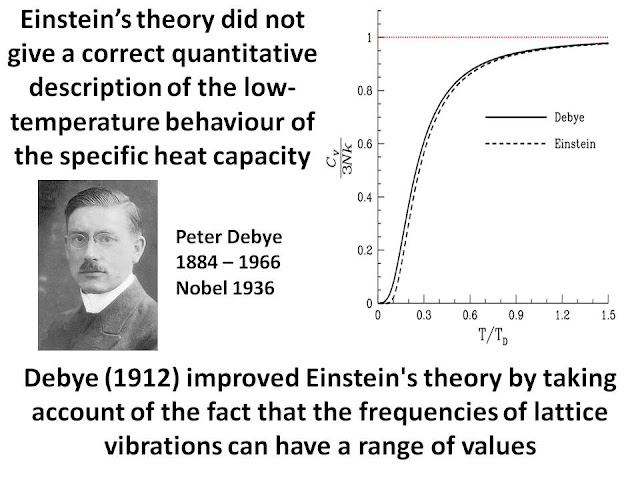
Specific Heat of Solids... Another problem with Classical Physics!

Towards the end of the 19th Century, classical physics had serious difficulties in explaing many observations. Einstein provided a solution of the specific heat of metals problem by assuming that energy absorption is quantised and is not continuous. This was a radical departure from the way physics was done in the 19th Century and demonstrates yet again the bold and visionary nature of Einstein's genius.
In the following I have published my slides from the talks on Einstein and the Theory of Relativity...


Sunday, 12 December 2010

Einstein Rides a Light Wave...


This is a thought experiment Einstein might have done (not necessarily in the way I have described but the idea is interesting)
A light wave is an electromagnetic wave (EM Wave) which has oscillating electric and magnetic fields. Suppose Einstein travels with the wave at the speed of light! What will he see?
He will see a constant electric field - this will not generate any oscillating magnetic field which in turn cannot generate an electric field. There will be no oscillating electric and magnetic fields that typify an EM wave. It would seem that no wave would appear to exist.
This is the interesting part - if you travel with the speed of light then you can not transmit or receive information: there are no EM waves.This encouraged Einstein to postulate that speed of light is the maximum speed allowed and nothing can move with a speed greater than the speed of light.

Not tremendously convincing but the idea is interesting.

Friday, 10 December 2010

On the Nature of Light: Wave-Particle Duality


Three fundamental quantities that help us to perceive the world around us

Space 3-D space - We can use a ruler to measure this
Time - Use a clock - atomic clocks can be accurate to 1 sec in a billion years
Means of transmitting information – LIGHT or EM waves in general…..

The speed of light is the fastest speed at which information/energy can travel
Speed of light is 300,000 km per second
The finite speed of light means that the time we receive the signal is later than the time the signal left the source (we are observing what happened in the past). This situation may be different for different observers and can create some bizarre effects.
Light plays a fundamental role in the theory of relativity.

Puzzling behaviour of light: Sometimes light acts as a wave while at other times it behaves like a stream of particles (photons) - Light displays a dual nature

But first a brief history:
1675 - Isaac Newton thought that light was composed of corpuscles (particles of matter) which were emitted in all directions from a source. Newton Published Optiks in 1704
Despite some serious problems with this view, Newton’s reputation helped the particle theory of light to hold sway during the 18th century

Robert Hooke (1635 - 1703) proposed in 1660 a wave theory of light.
Christiaan Huygens (1629 - 1695)in 1690 suggested that light was emitted in all directions as a series of waves in a medium called the Luminiferous ether
Thomas Young (1773 – 1829) in 1801 performed the Double-slit Interference Experiment.
Some say that it is the most beautiful experiment in physics.

The observations of the double-slit experiment could only be explained if light behaved as waves...

In 1860s, Maxwell combined the fields of electricity, magnetism and light and predicted the existence of electromagnetic (EM) waves. In his brilliant and very successful theory, Maxwell showed that all EM waves travel at 300,000 km/s which was the same as the measured speed of light.
Light is the “visible” EM wave
EM waves span a wide spectrum from radio waves to nuclear gamma rays


It was thought that as a wave motion, light would require a medium to travel - such a medium was called ether which was supposed to pervade the whole universe and had some really bizarre properties like being extremely stiff to allow vibrations of very high frequencies, be extremely thin (rare) to allow unimpeded motion of planets and objetcs through it etc. Attempts were made to measure the speed of the Earth relative to the ether but even the most sensitive experiments failed to find any evidence of the expected relative motion.
This caused a big headache for physicists at the end of the 19th Century.

Thursday, 9 December 2010

Einstein suggestes quantum nature of Light - Photoelectric Effect

Photoelectric Effect - Another Problem for Classical Physics
Photoelectric effect is the emission of electrons from a metal surface by gaining energy from light.
First observed by Heinrich Hertz (1857 – 94) in 1887
Studied in detail by Philipp Lenard(1862 – 1947) in 1902
Lenard was awarded Nobel Prize in 1905

According to classical physics, the metal surface simply soaked up light energy and sooner or later, depending on the intensity of the light, it would accumulate enough energy to cause emission of electrons.
Experiments did not verify this and cast doubt on the validity of the wave theory of light – a cornerstone of Maxwell’s theory of electromagnetic waves

Experimental results were:
1. If the light is below a certain frequency f0 , then no electrons would be produced however long we shine it on the metal surface.
2. For light frequency above f0 electrons would be produced immediately, with no time delay even for extremely weak light intensities


In 1900, to explain a problem with black-body radiation spectrum Planck had made an ad hoc assumption that emission and absorption of energy can occur only in discrete amounts.
Einstein made the bold assumption that light consists of a stream of particles; the energy of individual particles or quanta is determined by the frequency of light. Einstein’s light quanta are now called photons
Energy of a photon is E = h x f where h is the Planck’s constant.

According to Einstein, in photoelectric emission, a light photon penetrates the metal and knocks an electron loose. A minimum energy is required to knock off an electron from the metal. Hence photons below a certain frequency f0 do not have sufficient energy (= hf0) to release electrons. Increasing the intensity of the light increases the number of photons and hence the number of electrons emitted would increase.

Einstein’s theory raises a fundamental question:
Is light a wave, or a stream of photons?

Wednesday, 8 December 2010

Black Body Radiation - Planck's Solution

(Planck’s assumption of) ...the atomistic (quantum) structure to energy, governed by the universal constant h ... became the basis of all twentieth-century research in physics and has almost entirely conditioned its development ever since. ... Albert Einstein 1950

Every body radiates energy over a range of wavelengths.
How much energy is emitted at each wavelength (shape of the curves) is predicted by the classical theory. Well established theories of Thermodynamics, Statistical mechanics and Electromagnetism
form the basis of such predictions.

In 1900 Planck suggested that physics should abandon the assumption that energy is continuous and wavelike. Instead, if energy can only be absorbed and emitted in discrete packets (or quanta now called photons ), theory can be made to fit observations exactly.

Energy of a quantum = h x its frequency

Planck’s suggestion was ad hoc and had no theoretical basis This troubled a lot of people including Planck. Planck believed in the wave nature of light (energy) and insisted that it might be in the way individual matter atoms interact with radiation that gives rise to the quantum aspects in the emission of radiation. It was Einstien who in 1905 first suggested that light (energy) is actually quantised following Planck's equation.

Planck was awarded Nobel Prize for his work in 1918. Planck and Einstein became good friends. Planck supported Einstein during the turbulent period when Jews were being prosecuted in Germany.

Problems with Classical Physics around the year 2000

Some selected pioneers in the development of Physics
Leucippus (first half of 5th century BC) first proposed atomism
Archimedes (287 BC – 212 BC) derived many correct quantitative descriptions of mechanics, statics, hydrostatics, levers etc.
Of the modern physicists, the most famous is Isaac Newton (1642 - 1727) who built on the works of Galileo Galilei (1564 - 1642) and Johannes Kepler (1571 - 1630)
James Clerk Maxwell’s (1831 – 1879) theory of electromagnetism unified the fields of electricity, magnetism and optics
The work of Albert Einstein (1879 – 1955) marked a new direction in physics that continues to the present day.

Between 1600-1900 AD, great progress was made in explaining the way the world is organised. Classical physics was largely based on observations at macroscopic scale and at modest values of velocities - the laws of physics were very successful in explaining a large body of empirical data.
However, the world operates on the atomic/molecular level.
Speeds at which electrons and other particles move are comparable to the speed of light. Physics works differently for these conditions.

Quantum Physics and Relativity provide the theoretical basis to understand the new physics. The results of quantum physics and relativity reproduce those of classical physics for macroscopic systems and for low velocities.

By the end of the nineteenth century, the general belief was that science and technology are fully developed. In 1897 Charles H. Duell, Director of the US Patent Office, advised President McKinley to close down the Patent Office, because it no longer serves a purpose since:
“Everything that could ever be invented had already been invented”!

but physicists were worried...

Serious cracks had begun to appear in Classical Physics!

By the year 1900, Classical Physics started to have serious difficulties with the experimental results from black-body radiation, photoelectric effect etc.
Results were in contradiction with the fundamental laws that had served well for the past two centuries.

Additionally, the nature of light and of the newly discovered X-rays and nuclear radiation just did not make sense. Probably most serious of all, physics could not define a reference frame with respect to which laws could be stated – the whole framework on which physics was based was in doubt!