About Me

My photo
Science communication is important in today's technologically advanced society. A good part of the adult community is not science savvy and lacks the background to make sense of rapidly changing technology. My blog attempts to help by publishing articles of general interest in an easy to read and understand format without using mathematics. You can contact me at ektalks@yahoo.co.uk

Wednesday, 21 February 2018

Undefined/Indeterminate Mathematical Operations Involving Zero and Infinity lead to fallacies and paradoxes

List of Blogs

I regularly receive emails and messages that claim to prove statements like 2 is equal to 1, 0 divided by 0 is 1 etc.  Such proofs almost always contain an indeterminate mathematical step (an operation where the the result is ambiguous) leading to paradoxical/fallacious conclusions.  
Another common error is to treat infinity as a number.  While infinity is a useful concept for indicating a limiting situation of increasingly larger numbers, it must not be treated as a number for mathematical operations.

Mathematics deals with numbers; each number has a well defined value or magnitude.  Manipulation of numbers is vital for our society to function efficiently - such manipulations follow well defined rules of addition and subtraction.  Results of such operations are unique and should have no ambiguity.  If there is ambiguity - the result is indeterminate, and for this reason they are unacceptable.
First let me explain why infinity () is not a number:
a.  If we think of infinity as a number that is larger than all finite numbers, then one can always think of a real number that is larger than that.
b.  Arithmetical operations do not apply to infinity - ability to add, subtract etc. is essential to the concept of a number.  For example;  if we write
          ∞ + 1 = ∞ + 2 =  
then it implies that 1 = 2 = 0, and also that infinity is a number that is larger than itself.
Similarly, if we write   1/∞ = 0 and also  2/∞ = 0 then it seems that 1 = 2 which is absurd.
c.  Greater-than, less-than, equal-to relations do not apply in the same way to infinity as they do to finite numbers.
d.  Infinity is a useful concept to indicate the limits to which the value of an expression approaches - for example, if x decreases from positive values towards zero then the value of 1/x increases, reaching the expression 1/0 at x = 0.  While 1/0 in indeterminate, the limiting value of 1/x as x gets ever close to zero is exactly definable.
                limx0(1/x= +∞     ≥ 0

The trend is shown in the slide


The above equation simply suggests that the limit, when x approaches zero, tends to infinity (an extremely large number) - it does not say that the value ever reaches infinity, rather that 1/x is increasing towards an extremely large positive value.
If x were changing towards zero from negative values then the limit will be written as 
                  limx0(1/x= -∞     ≤ 0

and the equation simply says that as x approaches zero, 1/x tends towards an extremely large negative value.  

Since, we can not treat infinity as a number, any mathematical operations involving infinities must be treated as 'not allowed'.  There might be special situations where one could consider infinity as a number and do maths with it, but we have to be very careful and watch out for paradoxical situations arising.  Hilbert's Infinite Hotel Paradox, Thomson's Lamp Paradox, 1 = 0.9999... are some well known examples.
Expressions (not a complete list) like 0 x ∞, ∞ + ∞, ∞ - ∞, p^∞, ∞^0 are indeterminate.

Infinite Series: Summing infinite series present some interesting situations.  If an infinite series is convergent then there is no problem, the nth term when n is very very large is going to be infinitesimally small and does not affect the sum in a material way. But what is the value of S for the infinite series:

S = 1 - 1 + 1 - 1 + 1 - 1 ...

We can organize the series in three different ways

S = (1 - 1) + (1 - 1) + (1 - 1) ...     = 0 + 0 + 0  ... = 0

S = 1 - (1 - 1) - (1 - 1) - (1 - 1) ...   = 1 - 0 - 0 - 0  ... = 1

S = 1  - S   or  2S = 1   which gives S = 1/2

Even though the first method has an infinite number of terms, in the second and third methods, we have one extra term. They are different series.

1 = 0.999...  :  This is my favourite fallacy.  Consider that 

                   x = 0.999999...            (eq.1)

three dots represent recurring nines to any large number (normally we say to infinity).  Multiply eqn. 1 by 10 on both sides

                 10 x = 9.999999...  =  9 + 0.999999...  =  9 + x          (eq.2)

From eq. 2;       10 x - x = 9 x = 9   or   x = 1

Therefore              1 = 0.999999

The problem with this type of proof is that the number of recurring nines in eq.1 is one more than in eq.2.  In eq.2, '0.999999...' is a different number from that in eq.1 and that creates the fallacious result.

Division by zero:   In mathematics, division is opposite to multiplication.  If a divided by b is equal to c, then c multiplied by b must be equal to a.  This rule does not work when we divide by zero.  
For example, let p = q/0; but p x 0 = 0 for all values of p (I shall deal with  the case of 0/0 later). There is no number p that, when multiplied by zero gives any other number except zero, therefore, it is fallacious to say that q/0 = p.  Dividing by gives a very large number in the limiting case when x0 but the limit when x = 0 is undefined.
Another way of looking at 'division by zero' is to consider division as a subtraction process - 24 divided by 6 is a subtraction process of taking away 6 sequentially until nothing remains.  The steps are;
24 - 6 = 18
18 - 6 = 12
12 - 6 =  6
 6 - 6  =  0
Four steps - 24 divided by 6 is 4.
When we divide 24 by zero, the steps will be as follows:
24 - 0 = 24
24 - 0 = 24 ...  for ever.  
The normal rules of division do not work when we divide by zero.
  
Zero divided by zero:  From our discussion above, 0/0 is not defined.  
We can look at 0/0 as follows:

zero divided by any number is zero - so 0/0 must be 0.
Any number divided by itself is equal to one - so 0/0 must be 1.
One can not have ambiguity in mathematical manipulations and the only conclusion we can draw is that zero divided by zero is undefined/indeterminate.

Zero multiplied by infinity:  If we start with the argument that any number, however small,  multiplied by ∞ gives infinity, that is,

               a x ∞ = ∞    then for a = 0, we obtain  0 x ∞ = 

However,  if limx0(1/x= ∞  then  limx0(x/x=   limx0(1) = 1

                                                   limx0(x^2/x) =  limx0(x) = 0
                    
                                                                  limx0(x/x^2limx0(1/x) = 

Essentially, 0 x ∞ has no meaning in terms of mathematical operations.

Zero raised to the power zero (0^0): 

 What is the value of 0^0 ?  We know that any number raised to the power 0 is equal to one.  
Also we can multiply zero any number of times,  but we always get zero:

                    x^0 = 1  and  0^x = 0

these are valid mathematical operations.  However, in the limit, when x goes to 0, both expressions reduce to zero to the power zero - the first one is equal to 1 while the second one is equal to 0.
This is inconsistent with being an unambiguous result and for that reason unacceptable.  Zero to the power zero is indeterminate.

The Limit Paradox:  This is a paradox, I like very much.  Consider the equilateral triangle ABC.  All three angles of the triangle are equal to 60 degrees and the sides are the same length:

                               AB = BC = AC = a

D, F and E are midpoints of sides AB, BC and CA respectively. Therefore, triangle ADE and EFC will also be equilateral but sides of length a/2.


Now,                AB + BC = 2a = 2 x AC
also             AD +DE +EF + FC = 2 x AE + 2 x EC = 2 x AC  = 2a

We can continue to half the sides, and as shown above, the sum of the sloping sides will be equal to 2 times the base AC.

If we continue the process an infinite number of times then the sloping sides and the base coincide but according to our analysis the sum of all the sloping sides is twice the length of the base. This is a paradoxical result.

Again, the resolution is found in our concept of infinity.  The sloping sides are that way as long they are not horizontal - the height of the triangle is not zero.  then the angle of the tiny equilateral triangles formed remains at 60 degrees.  It collapses to zero as the sloping side coincides the horizontal base and in this limiting case - we do not have equilateral triangles any more - it is a different situation entirely. 

Final Word:  This publication was meant to discuss some indeterminate mathematical operations in a language accessible to non-specialists.  I have done away with formal statements as much as possible (I have not even used words like sets, axioms etc.) and for that reason, this blog piece may not be appreciated by the purist - but this is community education site.  
The main conclusions are: (a) Be very very careful when handling infinities -they are not numbers in the usual sense of the word; (b) While zero could be called a number, its position at the junction of positive and negative number lines makes it quite tricky to handle - again be very careful when doing mathematical operations with a zero.

Hope you enjoyed the excursion into mathematical paradoxes - let me know at ektalks@yahoo.co.uk

Monday, 12 February 2018

Letter Frequency in Spellings of Words and Numbers in the English Language

Index of Blogs


The subject of this blog is completely different - I think it is insane.  
But I had to write it down as it appears so fascinatingly interesting, albeit useless.

If you look at the website (http://letterfrequency.org/), you can find the order in which letters of the alphabet occur in words of the English language.  They occur in the following order - highest frequency first:


e t a o i n s r h l d c u m f p g w y b v k x j q z
The first 12 letters are found in 80% of the words. 
Actual values are:


The story begins with my granddaughter writing to me to say that the spellings of numbers from zero to ninety-nine do not contain the first four letters of the alphabet, namely a, b, c and d.  I was surprised to see the letter a in the list as it is the third most frequent letter used in English language, and to be missing in the spellings of the first thousand numbers (it first appears in a thousand) would be curious.
I then got down to prepare a list of letters missing in number spellings. What use is it? - I have no idea but I think it is insanely interesting.
(The notation used here is: 10^n is 1 followed by n zeros; 10^2 is 100; 10^6 is 1,000,000 or 1 million; and so on)
       Letter                   First Appearance 

          a                 10^3  or 1,000  Thousand
          b                 10^9       or       Billion
          c                 10^27     or       Octillion
          d                 10^2       or       Hundred 
          j                 does not occur in any spellings
          k                does not occur in any spellings
          m                10^6       or       Million
          p                 10^24     or       Septillion
          q                 10^15     or       Quadrillion

I might have missed something and got one or more errors in the list - please let me know.

I could start looking at negative powers of 10 but I think that is taking things a bit too far.

I hope you enjoyed reading through the blog - slightly different from the usual serious stuff; this is what you get when you start talking to your grandchildren. 

Thursday, 8 February 2018

Math Puzzles - How logical approach makes them much more delicious


Take me to the INDEX of Blogs

I love math puzzles, especially those that require some logical thinking.  
Here, I have an example of a puzzle that you can solve by brute force; 
but using some logic, the puzzle becomes deliciously beautiful.

I look at a simpler version of the puzzle to show brute-force solution: 

Joan is in a room that has five bulbs (B1, B2, B3, B4 and B5).  
Each bulb can be individually switched ON and OFF by pulling a cord attached to it. 
Initially, all bulbs are OFF.     
Step 1:  Joan pulls the cord on each bulb and they are all ON.
Step 2:  Joan now pulls cord on every second bulb
Step 3:  Joan pulls cord on every third bulb
Step 4:  Joan pulls cord on every fourth bulb
Step 5:  Joan pulls cord on every fifth bulb
Which bulbs are ON at the end of Step 5?

Brute-Force Solution:  We can follow the sequence:

Step 1:  By pulling cord on each bulb, Joan switches them all ON - all five bulbs B1, B2, B3, B4 and B5 are ON

Step 2:  Joan pulls cord on bulbs B2 and B4 and they will be switched off.  
The situation is;
B1 - ON;  B2 - OFF; B3 - ON;  B4 - OFF; B5 - ON

Step 3:  Joan pulls cord on B3 and it is switched OFF.  
Now:  B1 - ON; B2 - OFF; B3 - OFF; B4 - OFF; B5 - ON

Step 4: Joan pulls cord on B4 and it is switched ON.  
Now:  B1 - ON; B2 - OFF; B3 - OFF; B4 - ON; B5 - ON

Step 5:  Joan pulls cord on B5 and it is switched OFF.  
Now:  B1 - ON; B2 - OFF; B3 - OFF; B4 - ON; B5 - OFF

Bulbs 1 and 4 are ON after Joan finishes step 5.

I have tried brute-force method for 10 bulbs and the answer is that bulbs 1, 4 and 9 are ON.

The answer gives us a clue that bulbs that are at whole square numbers are left ON after the iteration. For 100 bulbs, bulbs 
1, 4, 9, 16, 25, 36, 49, 64, 81 and 100 will be ON.
Why is it so?

In the beginning all bulbs are OFF.  At the end of the ON/OFF/ON/OFF....sequence - 
a bulb will be OFF if its cord is pulled an even number of time  but 
it will be ON if the cord is pulled an odd number of times.

Bulbs at prime numbers will only be pulled twice (step 1 and step of prime number) so they will be OFF.
Let us look at the factors of some non-prime numbers:
12: Factors are 1,2,3,4,6,12 - 6 factors - even - bulb B12 will be OFF
20: Factors are 1,2,4,5,10,20 - 6 factors - even - bulb B20 will be OFF
44: Factors are 1,2,4,11,22,44 - 6 factors - even - bulb B44 will be OFF
72: 1,2,3,4,6,8,9,12,18,24,36,72 - 12 factors - even - bulb B72 will be OFF
In fact, all numbers that are not whole squares can be shown to have even number of factors and will therefore be OFF.

Now look at the factors of numbers that are whole squares: 
16 - 1,2,4,8,16 - five factors - odd - bulb B16 will be ON
25 - 1,5,25 - three factors - odd - bulb B25 will be ON
64 - 1,2,4,8,16,32,64 - seven factors - odd - bulb at B64 will be ON
and so on.

Why is it so? - If you look at the factors of non-whole-square numbers, you notice that factors come in pairs:  72 has (1,72 and 72,1); (2,36 and 36,2) etc.  This makes the total number of factors to always be an even number.

In whole-square numbers the square root makes its own pair and the number of factors is always an odd number - for example:
36 - has (1,36 and 36,1); (2,18 and 18,2); (3,12 and 12,3); (4,9 and 9,4); (6,6) - total factors are nine - an odd number. 

Hope you enjoyed the puzzle.  

Finally:  Do you know that 1729 is a special number such that the sum its digits (=19) multiplied by the reverse the digits in the sum (=91) is equal to 1729;  that is 19 x 91 = 1729!
Besides 1 and 81, 1458 is the only other number that I know which has this property.

Tuesday, 30 January 2018

The Awesome Number 2 : Puzzles, Games, The Power of Doubling

Index of Blogs


There are many games and puzzles based on the number 2; I shall discuss some in this blog.  

Number 2 is the only even number that is also a prime number. It is also one of the factors of all even numbers. 
(By the way - did you know that every even number may be expressed as sum of two prime numbers - amazing!)

What I find interesting is that many things around us manifest duality - in cultures, languages, philosophy, evolution.  One talks about 
mind and matter; good and evil; high and low; right and left; up and down; front and back; right and wrong; loss and gain;... the list goes on - see if you can think of some yourself. 
It may be that, to make sense of the complex world around us, we need to look at it in the simplest way possible.  Defining two extremes is a convenient way to set reference points for managing complexity. 
Politicians make important points in groups of three and look at the mess they have created - not able to cope really. 

The Power of Doubling:  The following example demonstrates the power of the number two:
Take a sheet of A4 printing paper.  Let us assume that its thickness is 0.1 mm. 
Fold it over once to make its area half - thickness is now 0.2 mm.  
Fold again (second fold) - thickness is 0.4 mm.  
If we continue to fold the paper 40 times (can certainly be done in a thought experiment), then the thickness will increase - say, to a value H.  
What do you think - make a guess how big H is?
Would you believe that the thickness will be ~ 100,000 kilometres!!
That is the power of doubling! It is the basis for understanding the ideas behind exponential growth (some people think it should be called runaway growth).  
For some of my favourite examples of the power of doubling, click 1, 2.

(The next slide sets out some simple mathematical background.  You can miss it out without loss of continuity but we shall use some of the results; click on the slide to see full page image)


We have looked at an example of doubling in folding of an A4 paper.  
Let us consider one more example of the interesting fable to further demonstrate the power of doubling. 

Pleased with the musician, the king asked him to choose any prize he wished for.  The musician asked for some grains of wheat.  He asked that on a chess board a grain be placed on the first square and the number of grains is doubled on each subsequent square.  the king laughed at the naivety of the musician and granted his wish.  This is what happened:


All the wheat in the kingdom was not enough to fill the board!

Let us now consider an example of the second case (eq. 3) where each successive term halves.

Example:  A bouncing ball is dropped from a height of 1 m on a concrete floor.  The ball bounces back to half its original height viz. 0.5 m.  In the next bounce its rise is halved again to 0.25 m; and so on.  The ball bounces about 20 times before coming to rest.  What is the total distance the ball bounces before coming to rest?
Solution:  The ball will travel a total distance S as follows: The ball travels the initial 1 m and then it  rises and falls in each of the 20 bounces)

S = 1 + 2 x (1/2 + 1/4 + ...   20 terms)  i.e. n = 20

From eq.3 in the slide S = 1 + 2 x (1 - 1/2^19) ~ 3 m
(1 in brackets is shown red to point out that the first term in the sequence is absent and is accounted for by subtracting 1 from the sum)
The value of the term  1/2^19 is very small and may be neglected for ease of writing the result.

You can also solve the puzzle by simply summing the heights traveled by the ball in successive bounces:
S = 1 + 2 x (0.5 +0.25 +0.125 + 0.0625 +...) 
and arrive at the same answer.  I think the first method is more elegant.

Doubling is the basis for understanding and planning in situations like population growth, increase in bacterial populations, nuclear power production, inflation, banking and much much more.  

I now look at a couple of mathematical puzzles where the number 2 plays a crucial role:

Puzzle 1:   What is the lowest number of weights you need to weigh objects from 1 kg up to 50 kg. Weight of each object is an integral number of kg.

Solution:  You might remember that in the series 
1, 2, 4, 8, 16,.. for any term, the sum of preceding terms is one less than the value of the term.  
For example: 1 and 2 add to 3 that is one less than 4
1, 2 and 4 add to 7 that is one less than 8
1, 2, 4 and 8 add to 15 that is one less than 16
This holds for all terms in this sequence (an example of a geometric series).
To measure integral kg weights up to 50 kg, we need weights 1, 2, 4, 8, 16 and 32 - altogether 6 weights.  You can check that these will actually work fine.  In fact, the weights will measure objects up to 63 kg.

Puzzle 2:  What is the lowest number of weights you need to weigh objects from 1 kg up to 50 kg. Weight of each object is an integral number of grams.

Solution:  This is an extension of puzzle 1.  We still need to weigh integral kg, so we need the 6 weights as before.  But we now also need to weigh from 1 gram to 999 grams.  This means that we should have weights of 1, 2, 4, 8, 16, 32, 64, 128, 256 and 512 grams - 10 additional weights.  
This makes 16 weights altogether to be able to weigh object up to 50 kg with 1 gram resolution.  Not bad.

Sunday, 28 January 2018

Number Puzzles for Mental Arithmetic Enthusiasts

Index of Blogs

The following puzzles are based on some interesting situations that use least common multiple (LCM) of a set of numbers. 
LCM of a set of numbers is the smallest number that is completely divisible by each of them without a remainder.  
For example, LCM of 2, 3, 4 and 6 is 12.

You can also see more mathematical games here and here

(you can use a calculator if you wish; Answers at the end)

Puzzle 1:  In a party, the host wants to arrange exactly the same number of guests at each table. He tries to seat 4, 5 and 6 guests per table but finds that, in each case, the last table has only 3 guests.  However, if he tries 7 guests per table then they fit exactly.  How many guests did the host invite?

Some variations of the above puzzle, slightly more difficult, are:

Puzzle 2:  In a party, the host wants to arrange exactly the same number of guests per table. He tries to seat 4, 5 and 6 guests on each table but finds that, in each case, the last table has only 2 guests.  However, if he tries 7 guests per table then they fit exactly.  How many guests did the host invite?

Puzzle 3:  In a party, the host wants to arrange exactly the same number of guests per table. He tries to seat 4, 5 and 6 guests on each table but finds that, in each case, the last table has only 1 guest.  However, if he tries 7 guests per table then they fit exactly.  How many guests did the host invite?

Moving on to a different situation, consider the following puzzle

Puzzle 4:  Jack and Debbie want to combine their substantial stamp collections and prepare a new folder.  Sticking only odd number of stamps in a row, they find that when they use 
5 stamps in a row then 4 stamps are left in the last row
7 stamps in a row then 6 stamps are left in the last row
9 stamps in a row then 8 stamps are left in the last row
11 stamps complete all the rows perfectly with none left over.
How many stamps in total do they have?

Puzzle 5:  The priest wishes to arrange his congregation is rows such that all rows have exactly the same number of people.  He does not like 13 people, not an auspicious number, in a row.  
He finds that if he sits them in rows of 7, 8, 9, 10, 12, 14 or 15; then he is left with 6, 7, 8, 9, 11, 13 and 14 in the last row.  Not what he wants.  However, rows of 11 fill properly.
How many people are there in the congregation?


Answers:

1.  63  
2.  182  
3.  301  
4.  2519  
5.  2519


Friday, 26 January 2018

The Science of Hypothermia, Windchill, Frostbite - When Body's Thermal Regulation Mechanism is Unable to Cope...


Index of Blogs


We are endotherms (warm-blooded animals) and must maintain a nearly constant temperature (~37C) of blood (the core body temperature) circulating to the vital organs like brain, heart, liver and kidneys. Most of the heat loss happens from the skin which is held at a slightly lower temperature of 33C to 34C.  Mild hypothermia is defined when core body temperature falls to 35C but serious complications occur if the blood temperature drops further.
In hypothermia, skin temperature particularly at the extremities is much lower. It can be almost as low as the ambient temperature with extremities receiving very little blood flow (vasoconstriction).


Vasoconstriction is mediated by restriction of the capillaries in the dermis/subcutaneous tissue as shown in the slide

We consume 2000 Calories per day to supply metabolic energy needs of the body.  This generates energy at the rate of ~100 W which must be removed to maintain a constant body temperature.  Heat is generated mainly in the following activities:

a.  Metabolism of all the cells of the body
b.  Muscle activity - exercise etc.
c.  Effects of hormones such as thyroxine, testosterone
d.  Extra metabolism need for digestion, absorption, storage of food

The body's thermal regulation mechanism easily gets rid of this heat energy if the ambient temperature is around 23C - the main mechanisms of heat loss are:

a. Radiation of infrared waves (most important)  
b. Convection by air 
c. Evaporation of water (the sweat) on the skin by moving air.  
d. Respiration - moist warm gases given out during breathing
c. Conduction - through contact with solid material

The question we address in this blog is what happens when the ambient temperature is much lower than 23C. Heat loss by radiation increases rapidly at lower ambient temperatures and easily exceeds heat production to cause hypothermia.  
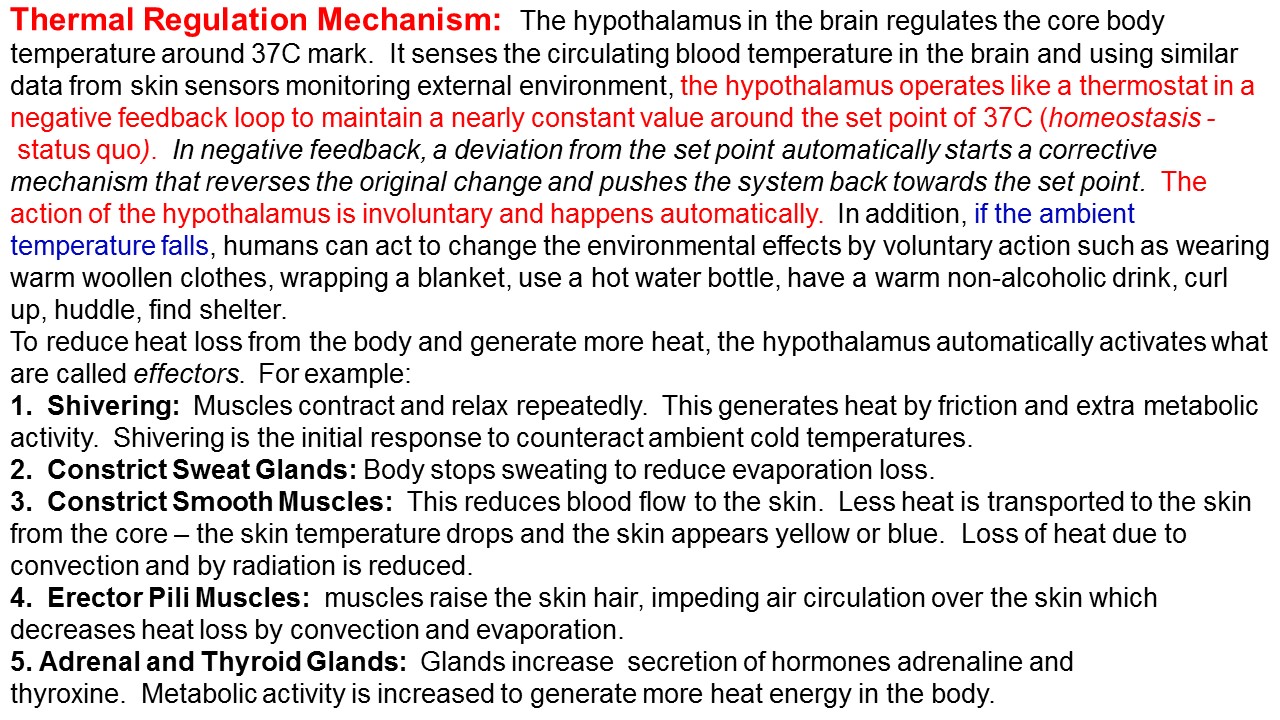
(Click on the slide to see bigger image; Press ESCAPE to return to text)


At the onset of hypothermia, as a first response, the body starts shivering - an involuntary oscillatory muscular activity that produces additional heat energy to warm the body.

Different stages of Hypothermia:  Hypothermia may be divided into several stages depending on its effect on the body:
Mild Hypothermia:  This results in symptoms such as shivering, numbness in hands and other extremities and reduced manual dexterity.  Complex skills become more difficult, the victim may also feel tired, may argue and become  uncooperative.  Difficulty in performing tasks such as fastening up clothing, putting on gloves, a hat etc. or taking them out of a rucksack may result in the victim getting irritated and ending up not bothering. This will of course make them get even colder.
How the physiological system is affected by progressively falling temperatures is discussed in detail here (see table 11-1, page 361 of the reference)
The final stage is profound hypothermia:  In this stage the body has effectively stopped trying to keep itself warm and some final steps are taken to avoid death. The heart rate and breathing slow so that they are hard to detect at all. Only one or two breaths per minute may be taken. The skin is very pale and icy cold to the touch. Metabolism has slowed so far that they are almost in a state of hibernation.
At a core temperature of around 28°C heartbeat irregularities may occur - called cardiac arrhythmias - this can lead to an uncoordinated twitching of the heart muscle preventing it from pumping blood properly and can result in death. Even if this does not happen, the heart will stop beating completely at around 20°C causing death.
When Thermoregulatory system is unable to cope:  If someone is exposed to cold and inadequately protected, their body will first try to generate more heat through shivering to maintain a normal temperature. If this does not solve the problem, the body will start decreasing blood flow to the extremities to curtail heat loss. Extremities will turn cold and appear blue.  If the loss of heat carries on despite these measures, in the final stages the body will slow its metabolism to minimize its need for fresh blood flow and oxygen supply.
Actually, the sooner the body reaches this final step,  better is the chance of survival as the organs won't be starved of oxygen. 

The Physics of Heat Loss from the Skin:  I now look at the physics of heat loss by the skin.  In hypothermia, the main mechanism of heat loss is by radiation.  The body has effectively switched off convection (vasoconstriction makes exposed extremities much colder, thereby reducing heat loss, also one wears woolen clothes to reduce air flow across the skin) and evaporation (switch off sweating).   

Radiation:  Every surface radiates and absorbs energy - how much? - depends on the area of the surface, its nature (mainly colour and texture), and temperature.  The law that governs the radiation of energy is called the Stefan-Boltzmann Law - heat loss varies as the fourth power of the absolute temperature (T in Centigrade + 273) of the radiating surface.  If we consider that human skin temperature is 33C and has an effective area of 1.0 square metre (actual adult body area is nearer 1.7 square metre but not all skin is exposed to air; clothes also affect radiation loss), then the energy lost per second is estimated as (remember that the body also absorbs heat radiated by the surroundings and it is the difference between heat radiated and heat absorbed that defines the heat loss by radiation)
   Ambient temperature    Energy Loss per second
             (degree C)                   (Watts)
                  30                              20
                  23                              65
                  15                              111
                  10                              137
                    0                              188
                 -10                              235
                 -20                              275

The net heat energy loss increases with decreasing ambient temperature; even at outside temperature of 15C, energy lost is greater than the heat generated by the calories consumed.  The above calculation actually overestimates the heat loss - the skin temperature falls below 33C as hypothermia sets in and the heat loss by radiation is reduced.  Considering an average skin temperature of 23C (extremities may be much colder but rest of the body will still be near 30C) and an ambient temperature of 0C (not uncommon during winter months), radiation heat loss will still be about 230W - too large for the body to compensate through thermo-regulatory mechanisms.

Convection:  is transfer of heat between our skin and the surrounding air.  How much heat energy is lost from the skin depends on the temperature difference between skin and surrounding air; it also strongly depends on whether the air is still or moving.  
Heat Loss per second = K A [T(skin) - T(air)]
K is convection coefficient and its value depends on the speed of air - the largest difference being between still air and moving air. 
Some values of K in units of W/m^2/C are listed below:
K =   3  for air speed =  0 m/s  (still air)
K = 26  for air speed =  2  m/s
K = 37  for air speed = 10 m/s
K = 41  for air speed = 20 m/s
The way it works is that our body warms a thin layer of air next to the skin.  This boundary layer acts as an efficient insulation reducing heat loss.  In convection, wind blows this boundary layer away and heat from the skin creates another boundary layer.  As wind continues to blow away such boundary layers, body looses heat energy and cools. 

For a 5 degree difference in temperature, power loss is about 20 W in still air, but increases to 200 W in moving air!  Convection is a very efficient method of heat transfer when there is a breeze present.

On a cold day, if you are indoors and properly clothed then heat loss by convection is not significant.  Outdoors with wind blowing is a different matter, and one can lose additional heat due to convection - the ambient temperature will feel much colder - this is called the wind chill factor that I discuss next. 


Wind Chill and Frostbite:  When outdoors, on a cold day, one feels that the temperature is lower than its actual value.  This is due to the combined effect of heat loss by radiation (indoors and/or outdoors) and convection (important when outdoors in the wind).  The wind chill factor (or wind chill temperature) is a measure of how it feels when the effect of convection due to wind is included. It feels that the temperature is lower than the thermometer value.  Note that your body temperature can never fall below the actual temperature even in windy conditions - only difference is that the body cools quicker when the wind speed is higher.
Frostbite happens when the body organ actually freezes (temperature falls below about -5C for an extended period).
The table below (adapted from) provides windchill temperatures (how it feels) and estimated frostbite times of peripheral organs like tip of nose, ear lobes, fingers and toes. (click on slide to see full page image)
Notice that even mild wind speeds cause serious wind chill.  For example - At a temperature of -20C, wind chill is -26.2C for wind at 5 mph; -33C at 20 mph and -38.2C at 50 mph.  This is because the heated boundary layer at the skins is swept away by even modest wind speeds and further increases in wind speed do not make a proportionate effect.

Frostbite mainly affects organs at the periphery that experience vasoconstriction (narrowing of the blood vessels) and do not receive much heat energy from the core of the body.  Below about -5C, freezing causes ice crystals to form in the tissue.  Ice crystals can damage cell membrane and small blood vessels in the frozen tissue.  I remember when I was living in Saskatoon, Canada, the advice was never to walk outside for more than 10 minutes as the ambient temperatures would go down to -44C in winter months! 
Most at risk of frostbite are people who are away from sheltered places - out in the open; e.g. military personnel, homeless people, sports enthusiasts.  Alcohol beverages cause your body to lose heat faster.  
Management of frostbite is a complex subject - please click here for more details.

End Note:  Human body maintains a state of homeostasis - parameters like core body temperature, blood sugar level, blood pressure and many more, are regulated in a narrow range by the hypothalamus in a negative feedback mode.  Hypothalamus does a wonderful job but it has its limits beyond which the regulatory mechanisms cannot cope.  
Human body produces 100W by metabolizing the food we eat (click here).  The regulation of temperature fails when the ambient temperature is too high (click here) or too low (covered in this blog) - this can be life threatening.  The science is well understood but the responsibility of keeping oneself safe rests with the individual.   

Finally, there are a couple of YouTube Videos (1, 2) which might be worth watching.